Tank Level Monitoring System: Sensor + Transmitter + Recorder Guide

Updated May 27, 2026 | Sino-Inst Engineering Team

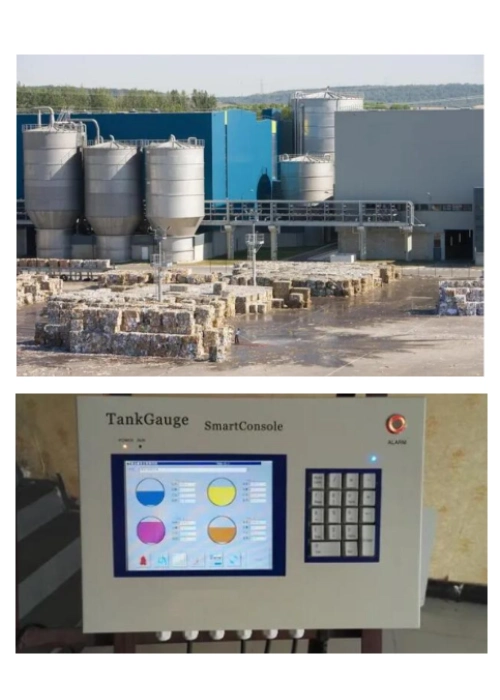
A tank level monitoring system is not a single sensor — it is three layers: the level sensor, the 4–20 mA or HART signal, and the recorder or SCADA that turns the signal into a usable display, alarm, and inventory log. Most failed installations get layer 1 right (pick the sensor) and skip layers 2 and 3 — then wonder why nobody trusts the readings. This guide walks the full stack: sensor technology selection, signal-path wiring, recorder integration, and three real installation cases.

Contents

The three layers of a tank level monitoring system

A working tank-level loop needs all three of these components, wired and configured to work together:

  • Sensor — the device that converts liquid level to an electrical signal. Radar, ultrasonic, hydrostatic pressure, guided-wave radar, capacitance, magnetostrictive, or float-based.
  • Signal transmission — the way that signal moves from the tank to the control room. Usually 4–20 mA analog, sometimes HART for diagnostics, Modbus RTU over RS-485 for multi-tank serial bus, or wireless (LoRa, WirelessHART) for remote sites.
  • Recorder / SCADA — the display, log, alarm, and integration into plant systems. Can be a standalone digital tank recorder, a PLC analog input card feeding a SCADA tag, or a cloud-connected gateway for inventory monitoring.

The most common installation failure is treating layer 3 as an afterthought. A radar sensor with no overfill alarm wiring is just a number on a display; it does not stop a spill. The recorder layer is where automation, logging, and safety interlocks actually live. For background on the signal layer, see our pressure transmitter working principle page — the same 4–20 mA loop math applies whether the sensor is a pressure transducer or a radar.

Five questions to ask before picking a sensor technology

Before any RFQ, walk these five. Wrong answer to any one rules out three or four of the seven common technologies.

  1. Tank geometry — vertical cylinder, horizontal cylinder, sphere, irregular underground? Tall narrow tanks (>5:1 H:D) suit guided-wave radar; flat-bottom storage tanks suit free-space radar; spherical tanks need radar or hydrostatic.
  2. Media type — clean water, viscous oil, slurry, foam, condensing vapor, hazardous chemical? Foam blocks ultrasonic; low-dielectric liquids (LPG, fuel) need guided-wave radar; corrosive media drives wetted-material selection per our wetted materials reference.
  3. Process conditions — temperature, pressure, vapor blanket, agitation? Above 200 °C rules out standard ultrasonic; sealed pressurized tanks need DP or radar; agitated tanks need anti-turbulence damping.
  4. Hazardous area classification — Class I Div 1, Div 2, Zone 0/1/2, IECEx, ATEX? Explosion-proof or intrinsically-safe certification narrows the supplier list and adds 30–50% to sensor cost.
  5. Required accuracy — ±2% is fine for surge tanks, ±0.5% is needed for inventory, ±0.05% is required for custody transfer. Custody-grade tanks justify magnetostrictive or servo gauges.

The biggest mismatch we see in field tickets is ultrasonic on foamy or condensing media. The sonic pulse scatters in foam and reads false-low; in tall narrow tanks the beam reflects off the wall instead of the surface. Both failure modes get blamed on the sensor when the root cause is wrong-technology-for-the-tank. For a sensor-by-sensor master reference, see our 7 types of tank level sensors guide.

Sensor technology comparison table (7 technologies)

TechnologyBest fitAvoid whenTypical accuracyRelative cost
Free-space radar (FMCW, 80/120 GHz)Storage tanks, flat-top sealed pressurized, hazardous areaHeavy condensate on antenna, dust above DT3±2 mm
Guided-wave radar (GWR)Tall narrow tanks, foam, low-dielectric (LPG, fuel)Heavy build-up on probe, mechanical agitation±3 mm
Ultrasonic (non-contact)Open water, wastewater, simple geometryFoam, condensate, vacuum, sealed tanks, >200 °C±0.5% FS
Hydrostatic (submersible / bottom-port)Open vented tanks, wells, sumpsSealed pressurized tanks without DP version±0.1% FS
Differential pressure (DP)Sealed pressurized tanks, boiler drums, reactorsNeed impulse-line maintenance, freezing risk±0.075% FS
MagnetostrictiveCustody transfer, fuel terminals, magnetic-friendly mediaHighly conductive slurries, magnetic media±0.05% FS
CapacitiveSmall tanks, sumps, conductive or non-conductive liquidsCoating build-up, dielectric drift over time±1% FS1.5×

Cost ratios are normalized against a basic ultrasonic transmitter as 1×. Custody-transfer applications (gasoline terminals, LPG depots, refining) routinely justify 4–5× cost premium for the accuracy. For sulfuric acid and other aggressive chemistries see our sulfuric acid tank level radar guide — non-contact radar wins because nothing touches the media.

How the signal reaches the control room

Once the sensor produces a level reading, it has to travel to the control room. Five common signal options:

  • 4–20 mA analog — the industrial default. Two-wire loop, 0% = 4 mA, 100% = 20 mA. Robust over 1 km cable runs, accepted by every DCS and PLC analog card. For the math on minimum supply voltage and burden resistor see our 4-20 mA conversion guide.
  • 4–20 mA + HART — same two wires, but a small digital signal overlays the analog. Lets you read diagnostics, change span, and pull secondary variables without disconnecting.
  • Modbus RTU over RS-485 — serial bus, up to 32 devices on one pair. Used for multi-tank installations where running individual 4–20 mA pairs is uneconomical.
  • WirelessHART / LoRa — battery-powered transmitter, no field cable. Used for remote pump stations, lift stations, and brownfield retrofits where conduit runs would cost more than the sensor.
  • Ethernet (Modbus TCP, EtherNet/IP) — for sensors with built-in network stacks. Emerging for new installations but still rare on legacy plants.

Default to 4–20 mA + HART unless cost forces a downgrade. The HART overlay costs nothing extra at the sensor (most modern transmitters include it), and the diagnostics save service calls. For wiring layout and shield-ground best practice see our transmitter installation guide — the rules are identical for level transmitters.

Recorder, SCADA, and overfill alarm wiring

The recorder is the layer that turns a 4–20 mA signal into a useful tank monitoring system. Three architectures cover ~90% of installations:

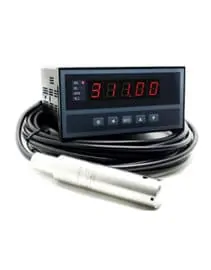
  • Standalone digital tank recorder — paperless recorder mounted at the tank farm or control room, with 4–20 mA / 0–10 V / RS-485 inputs and a touchscreen. Logs to internal memory or USB. Best for single-tank or small-farm installations. Our recorder line accepts 0–5 V, 0–10 V, 4–20 mA, 0–20 mA, and millivolt inputs simultaneously.
  • PLC + SCADA — sensor 4–20 mA wired to a PLC analog input card; PLC publishes to SCADA over Modbus TCP or OPC UA. Best for multi-tank, multi-process plants where level is one variable among many. Alarm logic and trending live in the SCADA.
  • Cloud gateway — sensor wired to an edge gateway that pushes data to a cloud dashboard over cellular or wired internet. Best for inventory monitoring across geographically distributed tanks (fuel terminals, water utilities).

For any tank holding hazardous or environmentally regulated media, the overfill alarm has to be wired separately — a second sensor (typically a vibrating fork or magnetic float switch), independent power, and independent shutoff valve. The primary level transmitter is for monitoring and trending, not for safety interlock. This is API 2350 standard practice for storage terminals and required by most environmental regulators. For SIL 2 or SIL 3 service per IEC 61511 / IEC 61508, the overfill sensor, logic solver, and final element must each be certified to the target SIL — a vendor’s SIL certificate covers only that one box, not the full loop.

Three installation case studies

Underground septic tank — 80 GHz radar

Customer needed level monitoring on a buried septic tank with irregular dome geometry. Hydrostatic was ruled out — the tank vent allowed evaporative cooling that altered head. We installed an 80 GHz FMCW radar through the existing manway lid. Beam angle 3° handled the dome curvature without false echoes. Output 4–20 mA to a standalone tank recorder. Background on similar underground installations is in our underground tank level guide. If the tank had been agitated or had heavy turbulence, we would have added a stilling well — see our stilling well sizing & install guide for the sizing rules.

Horizontal LPG tank — external ultrasonic

Customer wanted level monitoring on a 5-tonne horizontal LPG tank without drilling new ports. We installed an externally mounted ultrasonic level meter that reads through the tank wall using a high-frequency transducer. No process penetration, no hot work permit, no shutdown required. Accuracy ±2% FS — acceptable for inventory but not custody transfer. The horizontal cylindrical profile required a depth-to-volume lookup table in the recorder.

Diesel storage in hazardous area — explosion-proof ultrasonic

Customer needed level monitoring on diesel storage in an ATEX Zone 1 area (vapor recovery on-site). Standard ultrasonic was disqualified by certification. We installed an explosion-proof ultrasonic level transmitter (ATEX Ex d IIB T6) with intrinsically-safe 4–20 mA output to a barrier in the safe area, then to a tank recorder. Recorder logs daily inventory and pushes a SCADA alarm at 90% high level.

Tank level monitoring products

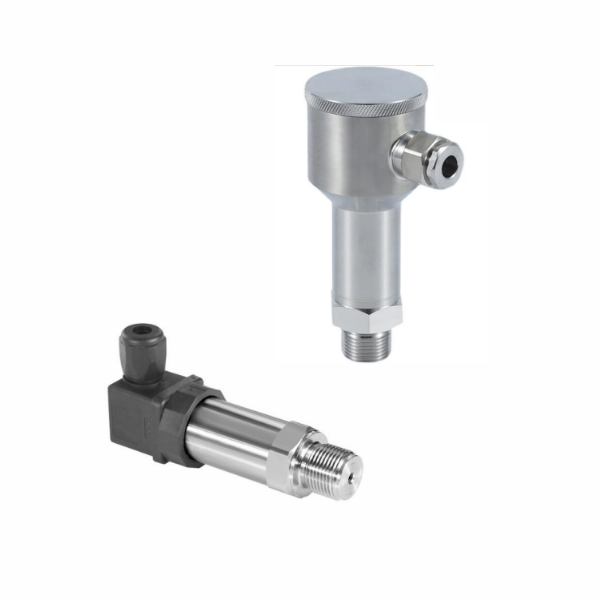
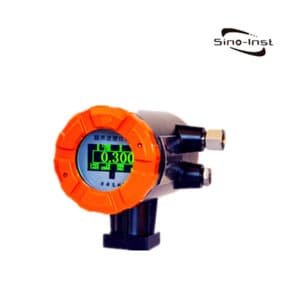
Non-Contact Radar Level Transmitter

80–120 GHz FMCW radar, narrow 3° beam, range 30 m. Non-contact, no maintenance, immune to dust, vapor, and foam. Suits storage tanks, hazardous-area and pressurized service.
Ultrasonic Level Sensor

External-mount or top-down ultrasonic for water, wastewater, and benign liquids. No tank penetration, ±0.5% accuracy, range to 15 m. Lowest-cost continuous level option for open vented tanks.
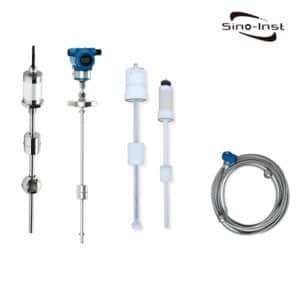
Magnetostrictive Level Transmitter

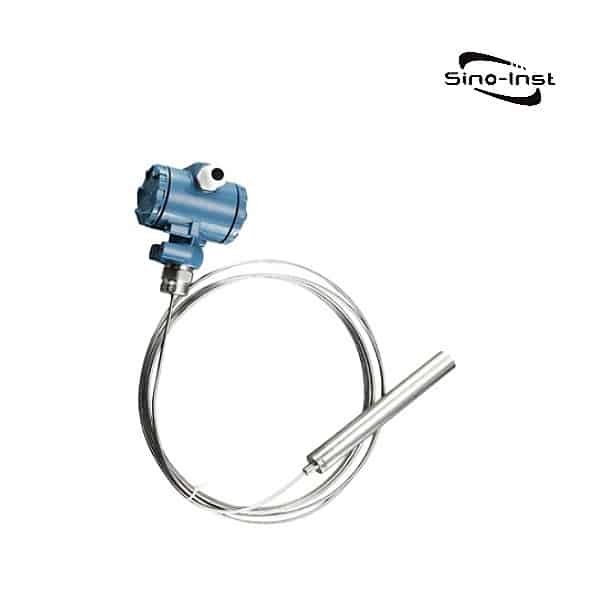
±0.05% custody-grade accuracy for fuel terminals and inventory tanks. Floating magnet on stainless probe, no moving electrical parts, decades of service life. 4–20 mA, HART, and Modbus output.

FAQ

What is a tank level monitoring system?

A tank level monitoring system is the full stack that turns liquid level into a usable plant signal — sensor, transmitter output, and recorder or SCADA. The sensor measures level using radar, ultrasonic, hydrostatic, or magnetostrictive technology. The transmitter converts that measurement to 4–20 mA or digital. The recorder logs, displays, and triggers alarms. All three layers have to work together for the system to be useful.

How do you choose a tank level sensor?

Walk five questions: tank geometry, media type, process conditions (temperature, pressure, agitation), hazardous-area classification, and required accuracy. Radar fits most flat-bottom storage tanks; guided-wave radar suits tall narrow tanks and low-dielectric media; hydrostatic suits open vented tanks; magnetostrictive is for custody-grade inventory.

Can one monitoring system handle multiple tanks?

Yes. Two common architectures: a PLC with multiple analog input channels feeding one SCADA, or a Modbus RTU RS-485 bus with up to 32 transmitters wired in series. A single tank recorder unit can typically handle 4 to 8 inputs; for more, a PLC is more economical and gives you alarm logic and trending out of the box.

Do I need a separate overfill alarm sensor?

For tanks holding hazardous or environmentally regulated media, yes. The primary level transmitter is for monitoring and trending; the overfill alarm has to be a separate sensor (vibrating fork, magnetic float switch, or capacitance switch) on independent power and an independent shutoff valve. This is API 2350 standard practice and required by most regulators.

What is the typical accuracy of a tank level monitoring system?

It depends on sensor choice. Ultrasonic ±0.5% FS, hydrostatic ±0.1% FS, free-space radar ±2 mm absolute, magnetostrictive ±0.05% FS. The recorder and SCADA layers add minimal error (typically < 0.1% if 16-bit analog inputs are used). For custody transfer, magnetostrictive or servo gauges are required.

Designing a new tank level monitoring system or replacing legacy gear? Send tank dimensions, media, process conditions, and hazardous-area classification — we will recommend a sensor, signal path, and recorder. For specific submersible applications see our submersible pressure transducer guide.

Request a Quote

Please enable JavaScript in your browser to submit the form

Stainless Steel Pressure Transducers: 316L vs 17-4PH Material Guide

Updated May 27, 2026 | Sino-Inst Engineering Team

For pressure transducer wetted parts, the choice between 316L and 17-4PH stainless steel is the single most important spec you put on the RFQ. 316L is the default for clean liquid, hydrogen, marine, and biocompatible service. 17-4PH is the default for high-cycle hydraulic and surge-prone systems. Get this wrong and you either lose accuracy under transient pressure (under-spec’d 316L on a pulsing hydraulic line) or burn money on stainless that fails in chloride service (17-4PH on sea water). This guide walks both, plus when to step up to Duplex or Hastelloy.

Contents

Where stainless steel sits in a pressure transducer

A pressure transducer has three metallic zones that may or may not see the process media:

  • Wetted parts — the diaphragm, process port, and any internal cavity that contacts the media. Material here decides corrosion resistance, hydrogen embrittlement, and biocompatibility. UNS S31603 (316L) and UNS S17400 (17-4PH) cover ~95% of industrial pressure transducer designs.
  • Sensor body — the structural casing that houses the electronics, behind the isolation diaphragm. Usually 304 or 316; never sees process media.
  • Process connection — the threaded or flanged fitting (1/4″ NPT, G1/2, ANSI flange). Same material as the wetted side, machined to ASME B1.20.1 for NPT or DIN 3852 for G-thread.

When a datasheet says “316L wetted parts,” it means the diaphragm and process port. The body shell is a separate spec and may downgrade to 304 to save cost. The diaphragm is the part that fails first — pick its material against the worst-case media chemistry the loop will see, not the steady-state nominal. Background on diaphragm failure modes is covered in our pressure transmitter working principle page.

316L vs 17-4PH: head-to-head comparison

Property316L (UNS S31603)17-4PH (UNS S17400)
FamilyAusteniticPrecipitation-hardened martensitic
Magnetic?No (non-magnetic)Yes (magnetic)
Tensile strength (MPa)4851100+ (H900 condition)
Yield strength (MPa)1701000+ (H900 condition)
Corrosion resistanceExcellent (chlorides, hydrogen, marine)Moderate (avoid chlorides, sea water, hydrogen)
High-cycle fatigue performanceAdequateExcellent — preferred for pulsing hydraulics
Typical max temperature+200 °C continuous+300 °C continuous
Hydrogen embrittlement resistanceYes — suitable for H₂ serviceNo — avoid hydrogen and cryogenic
Biocompatible (food, pharma)Yes (FDA, USP Class VI compatible grades)No
Relative cost (raw)1.0×1.1–1.3×

The trade-off is mechanical strength vs corrosion resistance. 17-4PH is roughly twice as strong as 316L, so the diaphragm can be thinner for the same rated pressure — which means better dynamic response and lower fatigue at high cycle counts. The cost is corrosion: 17-4PH pits in chloride environments, embrittles in hydrogen, and is not suitable for sanitary or cryogenic use.

For the same rated 60 MPa working pressure, both materials can be specified — but the failure mode is different. 316L will lose accuracy as repeated cycling fatigues the diaphragm. 17-4PH stays accurate longer but corrodes if the process chemistry sneaks outside spec.

When to specify 316L

Default to 316L when any of the following are true:

  • Hydrogen service — H₂, hydrogen-rich syngas, refinery hydrocrackers. 17-4PH will embrittle within months.
  • Marine or chloride-bearing media — sea water, brine, coastal-air installations. The molybdenum in 316L (2.1%) buys pitting resistance that 17-4PH does not have.
  • Cryogenic service — LN₂, LOX, LNG, LAr below −100 °C. 17-4PH becomes brittle and shatters; 316L retains ductility down to LHe temperatures.
  • Sanitary / food / pharma — 316L is the EHEDG and 3-A baseline. 17-4PH is not on the list.
  • Clean water, mild acids, lubricating oils — the default service envelope where 316L is more than adequate.

Steady-state ratings — 316L handles continuous service up to ~200 °C and most ranges from 10 kPa to 60 MPa. For high-purity applications, specify “316L low-carbon” rather than 316 (the L matters — it prevents weld decay). Clean-water service is the largest 316L use case; see our water pressure transducer family for water pipe / tank / well configurations. For air, nitrogen, hydrogen, and other gas applications, our industrial gas pressure sensors default to 316L wetted parts.

When to specify 17-4PH

Switch to 17-4PH (typically heat-treated to H900 or H1025 condition) when these conditions exist:

  • High-cycle pressure pulsing — hydraulic press feeders, fuel injection rails, paint sprayers running at >100,000 cycles per day. The diaphragm fatigue life of 17-4PH is 5–10× that of 316L.
  • Frequent pressure transients above rated — water hammer in pipework, surge spikes during pump start/stop. 17-4PH stays linear after a 1.5× over-range event; 316L starts drifting.
  • High working pressure with thin diaphragm — 100 MPa and above. The strength of 17-4PH allows a thinner diaphragm with the same burst rating, improving sensitivity at high range.
  • Service media that is benign chemistry — clean hydraulic oil, deionized water, instrument air, nitrogen (gaseous, not cryogenic). No chlorides, no hydrogen, no acids.

⚠ NACE MR0175 / ISO 15156 oil & gas warning: 17-4PH is NOT an accepted material under NACE MR0175 / ISO 15156 for sour service (H₂S-containing oil & gas equipment). If your spec calls out NACE compliance — every offshore, upstream, and refinery hydrocarbon service does — you must use 316L, Duplex 2205, Inconel 625, or another NACE-listed grade. Do not propose 17-4PH on these projects, even if the hydraulic-cycle argument seems to favor it.

17-4PH is also commonly chosen when machinability matters. It can be machined to tighter tolerances and threaded reliably, without the work-hardening problems of 316L. Our high-pressure product line uses 17-4PH for the diaphragm and 316 for the housing as a standard configuration. When troubleshooting transducers that drift after pressure surges, see our pressure transmitter calibration guide for the zero-trim procedure that often recovers 316L units before requiring replacement.

Escalation grades: 304, Duplex 2205, Hastelloy C-276, Monel

Outside the 316L / 17-4PH default, four grades come up on RFQs:

  • 304 (UNS S30400) — austenitic, no molybdenum, lower cost than 316L. Acceptable for clean water and air; avoid for any chemical service. Sometimes specified for transducer housings (non-wetted) but rarely for diaphragms.
  • Duplex 2205 (UNS S32205) — austenitic-ferritic blend, ~2× the chloride pitting resistance of 316L, stronger and cheaper than super-austenitics. Used for offshore oil, hot brine, and concentrated chloride brines (>50,000 ppm). Specify when 316L pits within 12 months in service.
  • Hastelloy C-276 (UNS N10276) — nickel-molybdenum-chromium alloy, near-immune to hot mineral acids (HCl, H₂SO₄, HF) and aggressive chlorides. ~5× the cost of 316L. Specified when service media includes >20% mineral acid at elevated temperature.
  • Monel 400 (UNS N04400) — copper-nickel alloy, specific resistance to hydrofluoric acid (HF) and seawater. Specified for HF alkylation units and submarine pressure ports.

For really aggressive media, a 316L transducer with a diaphragm seal is often cheaper than a Hastelloy transducer — the diaphragm seal isolates the transducer from the media using a chemically inert oil-fill and a sacrificial wetted membrane. See our wetted materials of pressure sensors reference for the full matrix.

RFQ checklist — five questions before you order

Before sending a pressure transducer RFQ, the procurement team should have answers to these five:

  1. What is the actual media chemistry? Not “water” — clean DI water, raw river water, sea water, brine concentration X%? Chlorides above 500 ppm rule out 17-4PH.
  2. What is the pressure cycle profile? Steady, slow-ramping (< 100 cycles/day), or pulsing (>1,000 cycles/day)? High cycles push toward 17-4PH.
  3. What is the maximum service temperature? Above 200 °C continuous → 17-4PH or step up to Inconel. Below −50 °C → 316L only.
  4. Hydrogen content in the media? Any H₂ presence above trace → 316L only. 17-4PH embrittles.
  5. What is the over-range / burst-pressure expectation? If 1.5× rated pressure is expected (water hammer, surge), 17-4PH gives margin. If steady, 316L is enough.

Once these five answers are in, the material choice usually becomes obvious. Our standard quote includes the recommended grade per service — see the underground tank level guide for an example of how grade affects sensor life in buried installations. For chemical-service tanks, the sulfuric acid storage tank guide shows when stainless transducers should be avoided entirely in favor of a non-contact radar.

Stainless steel pressure transducer products

SI-703 Flush Diaphragm Pressure Sensor

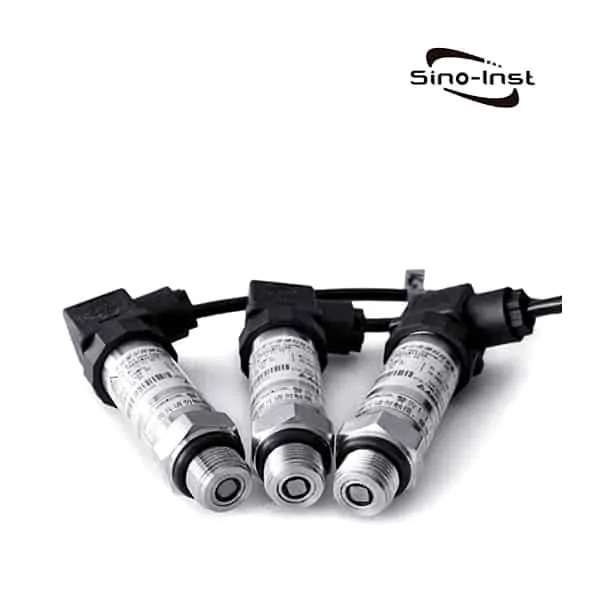
316L flush diaphragm for viscous, slurry, and sanitary service. Sub-flush profile prevents process build-up. Range 0–10 kPa to 60 MPa, ±0.1% accuracy, 4–20 mA output.

SI-702 High Pressure Sensor

17-4PH H900 diaphragm for high-cycle hydraulic and ultra-high pressure service. Ranges to 600 MPa, fatigue life >10 million cycles. Best for hydraulic presses and surge-prone loops.

High-Frequency Dynamic Pressure Sensor

Piezoelectric high-frequency sensor for combustion, shock, and pulsation studies. 316L wetted parts, response up to 100 kHz, ranges to 100 MPa. Used in engine test cells and ballistics.

FAQ

What is the difference between 316L and 17-4PH stainless steel pressure transducers?

316L is austenitic, non-magnetic, and resistant to chlorides and hydrogen — the default for water, marine, and biocompatible service. 17-4PH is precipitation-hardened martensitic, magnetic, twice as strong, and preferred for high-cycle hydraulic systems and pressure surge applications. 17-4PH should not be used for hydrogen, sea water, or cryogenic service.

Is 316L suitable for hydrogen pressure transducer service?

Yes. 316L is the standard wetted material for hydrogen service because it resists hydrogen embrittlement, which is the failure mode that destroys 17-4PH and other high-strength steels in H₂ environments. For trace-H₂ or hydrogen-rich syngas, always specify 316L low-carbon.

Why is 17-4PH used in hydraulic pressure transducers?

17-4PH has roughly twice the tensile strength of 316L. For a hydraulic system that cycles thousands of times per day with frequent pressure spikes, the thinner diaphragm in a 17-4PH transducer survives 5–10× longer than the equivalent 316L unit, while staying linear after over-range events. Clean hydraulic oil is benign chemistry, so corrosion is not a concern.

When should I specify Hastelloy or Duplex instead of stainless?

Switch to Duplex 2205 when chloride concentration exceeds ~10,000 ppm and 316L pits within a year. Switch to Hastelloy C-276 for hot mineral acid service (HCl, H₂SO₄, HF above 20% concentration at elevated temperature). For HF specifically, Monel 400 is the targeted choice. A 316L transducer with a diaphragm seal is often cheaper than a Hastelloy transducer for borderline cases.

What is the wetted material on a pressure transducer datasheet?

“Wetted material” refers to the surfaces that contact the process media — the diaphragm, the process port, and any internal cavity exposed to the fluid. The transducer body shell is separate and may be a lower grade. When comparing transducer datasheets, match wetted-material specs against the actual service chemistry, not against transducer cost.

Is 17-4PH stainless steel NACE MR0175 / ISO 15156 compliant?

No. 17-4PH is not on the accepted-materials list in NACE MR0175 / ISO 15156, which governs metallic materials in H₂S-containing oil & gas environments (sour service). For any project that calls out NACE compliance — offshore, upstream, refining hydrocarbon — specify 316L, Duplex 2205, Inconel 625, or another NACE-listed grade. 17-4PH is fine for clean hydraulics outside oil & gas, but cannot be substituted on NACE-spec’d jobs.

Need help picking grade for your service? Send process media composition (including trace species), pressure cycle profile, and temperature range — our engineers will recommend 316L, 17-4PH, or an escalation grade and quote accordingly. For installation context, our pressure transmitter installation guide covers torque specs and gasket selection by material.

Request a Quote

Please enable JavaScript in your browser to submit the form

Hydrostatic Pressure: Formula, Calculation & Industrial Measurement

Updated May 27, 2026 | Sino-Inst Engineering Team

Hydrostatic pressure is the pressure a liquid exerts on a point below its surface, equal to density × gravity × depth. In SI units, P = ρgh — and that single equation is the basis for measuring tank level, well depth, hydraulic head, and reservoir pressure in nearly every process plant. This guide walks the formula, an industrial worked example, the instruments that read it, and where it is used in the field.

Contents

The hydrostatic pressure formula (P = ρgh)

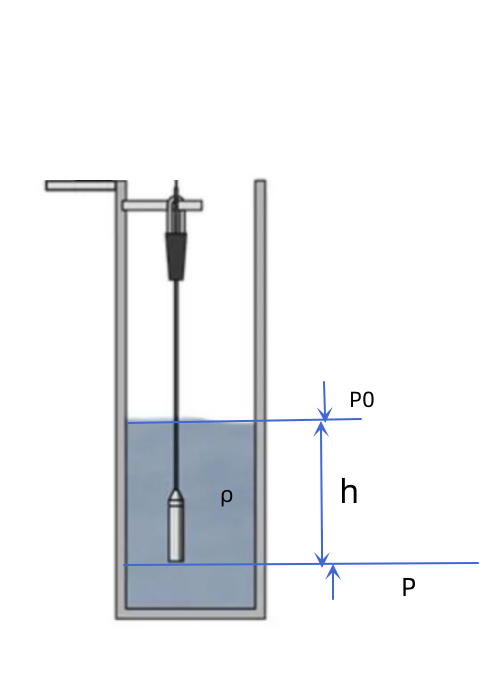
Hydrostatic pressure follows P = ρgh, where ρ is the liquid density (kg/m³), g is gravitational acceleration (9.80665 m/s² at sea level), and h is the vertical depth from the free surface (m). The result is in pascals.

A worked example. Take a water tank with 4.5 m of clean water above the bottom-mounted transducer port. Density of clean water at 20 °C is 998.2 kg/m³.

P = 998.2 × 9.80665 × 4.5 = 44,063 Pa ≈ 44.06 kPa ≈ 6.39 psi.

This is gauge pressure — pressure above ambient air. If you want absolute pressure (the value a sealed reference cell would read), add 101.325 kPa at sea level for the column of atmosphere sitting on top of the water. Units matter. Pa, kPa, bar, psi, and mmH₂O all show up on instrument datasheets, and the common units of pressure reference sheet has the cross-table.

LiquidDensity at 20 °C (kg/m³)Pressure per 1 m of head (kPa)Pressure per 1 m (psi)
Fresh water998.29.791.42
Sea water (3.5% salt)102510.051.46
Diesel fuel8328.161.18
Gasoline (light)7207.061.02
Sulfuric acid (98%)184018.042.62
Mercury13,546132.8419.27

The same 4.5 m head reads 28.4 kPa in gasoline but 81.2 kPa in sulfuric acid. A level transmitter calibrated for water will read wrong by 20–80% if the actual service medium is denser or lighter — always recalibrate or specify density when ordering, especially for chemical storage. See our sulfuric acid storage tank level guide for why radar is often preferred over hydrostatic for high-density acids.

Why container shape and area don’t matter

Hydrostatic pressure depends only on the vertical depth from the surface — not the volume of the tank, not the diameter, not whether the tank is cylindrical or rectangular. This is Pascal’s principle, sometimes called the hydrostatic paradox.

Two tanks side by side: one a 1 m diameter cylinder, the other a 5 m square pond, both filled to 2 m of water depth. Both bottoms see exactly 19.6 kPa. The 5 m pond holds 50× more water, but the pressure at the bottom is identical. This is why a pressure transmitter can read tank level regardless of tank geometry — the reading converts directly to height once you know the liquid density.

The same principle is why underground septic and storage tanks can use a single hydrostatic transducer dropped to the bottom: the irregular tank profile doesn’t change the reading at all. Volume is then computed from depth × tank-profile lookup table inside the recorder.

Where hydrostatic pressure shows up in industry

Hydrostatic pressure is the working principle behind several measurement and process tasks. The four most common in our project files:

  • Tank and well level — a hydrostatic transducer reads pressure at the tank bottom; the recorder converts to liquid height using ρ.
  • Pump suction head — engineers calculate available NPSH (net positive suction head) from the hydrostatic pressure at the suction side, minus vapor pressure.
  • Hydraulic system static charge pressure — accumulator pre-charge pressure is set by hydrostatic head of the working fluid in the column above it.
  • Hydrostatic pipeline testing — new pressure pipelines are filled with water and pressurized; pressure decay over time reveals leaks. Test pressure typically equals 1.5× design pressure.

In each case the underlying physics is the same — only the application context changes. For pump and pipeline systems, see how we discuss flow rate from pressure using Bernoulli and the related hydrostatic head term.

How temperature and gas head shift the reading

Three real-world effects change the hydrostatic pressure reading away from the textbook P = ρgh value:

  • Temperature — water density drops about 0.4% from 4 °C to 60 °C. For a 10 m tank that is a 4 cm level error if you forget to compensate. Most modern hydrostatic transmitters include onboard temperature compensation in the firmware.
  • Sealed tank with gas blanket — if the tank is sealed and pressurized (nitrogen blanket, vapor recovery), the gas pressure on top adds directly to the hydrostatic head. A standard gauge transducer will read total — gauge — not just liquid head. Use a differential pressure transmitter with the LP port piped to the vapor space to subtract the gas pressure.
  • Dissolved solids and slurry — water with 5% suspended solids reads 5% higher head. Calibrate against an actual sample at process temperature, not laboratory clean water.

The first item — temperature — is silent and frequently missed. A chilled-water tank operating at 4 °C reads 0.4% higher than the same physical depth at 20 °C. For high-accuracy custody-transfer applications, density is computed from a separate temperature sensor and used to back-correct the head reading.

Instruments that measure hydrostatic pressure

Three instrument families cover almost all field uses of hydrostatic measurement. Pick by mounting access, service medium, and required accuracy.

Submersible hydrostatic level transmitter

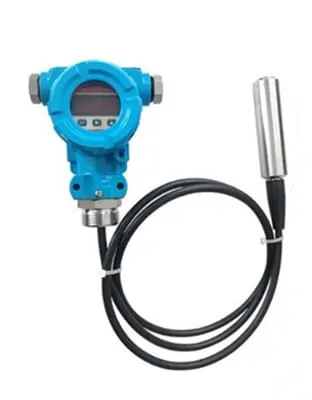
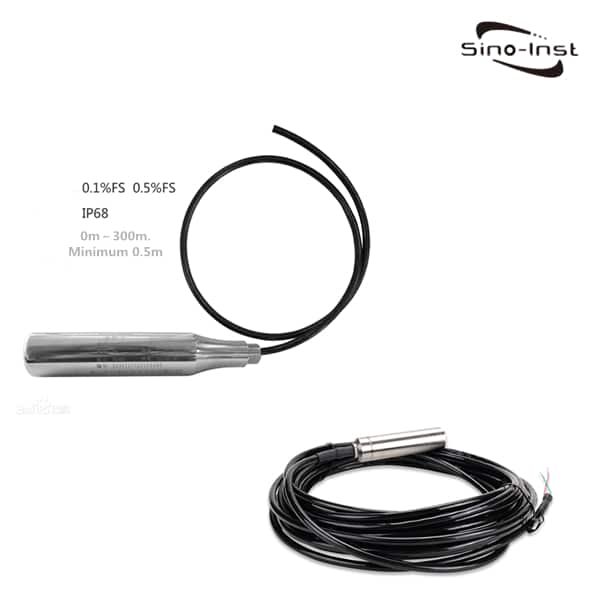
A sealed transducer lowered into the tank or well, cable length determines depth range. The diaphragm sees the full hydrostatic head and outputs 4–20 mA. Best for tall open tanks, wells, and sumps where the bottom is hard to drill. Selection details — IP68 cable jacket, vent tube — are in our submersible pressure transducer selection guide.

Bottom-mounted (or flange-mounted) pressure transducer

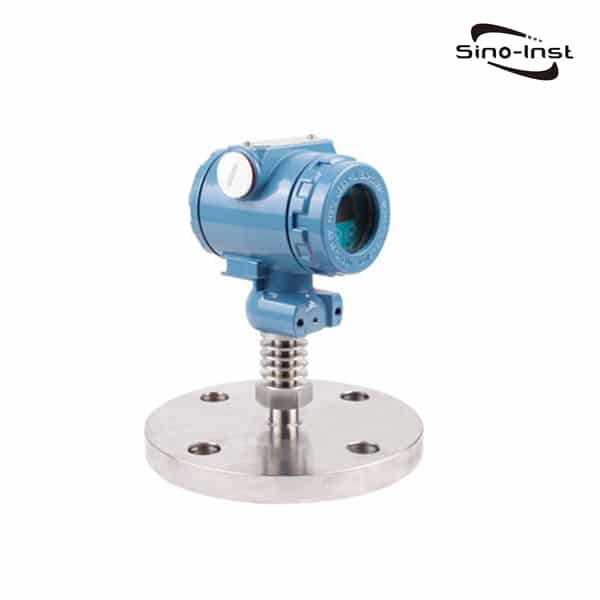
Installed in a 1/2″ or 1″ NPT port at the tank bottom, with the diaphragm exposed to the process. Most common in clean liquid storage. Use a diaphragm seal version for hot, viscous, or slurry service. For installation good practice see our pressure transmitter installation guide.

Differential pressure (DP) transmitter

Used on sealed pressurized tanks. The HP port reads bottom hydrostatic + gas blanket; the LP port reads the gas blanket alone via an impulse line to the top. The DP cell subtracts — output is liquid head only, independent of vapor pressure. Standard practice for boiler drum and reactor level service — see our 3051HP hydrostatic pressure transmitter for a drop-in DP cell optimized for tank-level service.

Convert hydrostatic pressure to liquid height

Given a pressure reading and known density, height is h = P / (ρg).

A worked conversion. Transducer reads 27.5 kPa in a diesel storage tank (ρ = 832 kg/m³).

h = 27,500 / (832 × 9.80665) = 3.37 m of diesel head above the transducer.

Pressure unit1 m of water head equals1 m of diesel head equals
kPa9.798.16
bar0.09790.0816
psi1.421.18
mmH₂O1000833
inH₂O39.3732.8

If your DCS receives the raw 4–20 mA from a pressure transmitter spanned for 0–100 kPa, the conversion to liquid height happens in the recorder. Our digital tank volume recorders ship with a lookup table for irregular tank profiles, so the recorder reads in m³ or gallons without the operator doing manual conversion. For a quick sanity check on a single value, the hydrostatic pressure calculator on our tools page does P → h for any liquid density in one step.

Pressure and level products for hydrostatic measurement

Hydrostatic Level Transmitter

Submersible level transducer for open tanks, wells, and sumps. 316L wetted parts, vented cable, IP68 rated. Range 1 m to 200 m of water column, 0.1% accuracy.

Differential Pressure Transmitter

DP cell for sealed pressurized tanks — boiler drums, reactors, vapor-blanketed storage. HP and LP ports subtract gas blanket, leaving pure liquid head. Up to 32 MPa static, ±0.075% accuracy.

Industrial Pressure Sensor

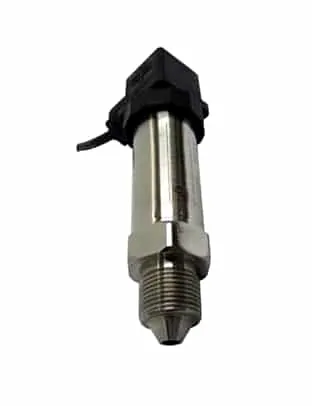
General-purpose bottom-port pressure transducer for clean liquid storage. 4–20 mA or 0–5 V output, ranges from 10 kPa to 60 MPa. NPT or G-thread process connection.

FAQ

What is the hydrostatic pressure formula?

P = ρgh, where ρ is liquid density in kg/m³, g is gravitational acceleration (9.80665 m/s²), and h is the vertical depth from the free surface in meters. The result is gauge pressure in pascals. Multiply by 1×10⁻³ for kPa or 1.45×10⁻⁴ for psi.

Does container shape affect hydrostatic pressure?

No. Hydrostatic pressure depends only on the vertical depth from the surface and the liquid density. A 1 m diameter cylindrical tank and a 5 m square pond filled to the same depth produce the same bottom pressure, even though the pond holds 25 times more water. This is Pascal’s principle.

How is hydrostatic pressure used in industry?

Four main uses: tank and well level measurement, pump suction head calculation (NPSH), hydrostatic pipeline pressure testing, and hydraulic accumulator pre-charge. Each application uses P = ρgh in a slightly different way but the underlying physics is identical.

What instrument measures hydrostatic pressure?

Three common families. A submersible hydrostatic level transmitter lowered to the bottom of a tank or well. A bottom-mounted pressure transducer in a flange or NPT port. A differential pressure (DP) transmitter for sealed pressurized tanks where the gas blanket has to be subtracted. All three output a standard 4–20 mA signal.

How does temperature change a hydrostatic reading?

Liquid density drops as temperature rises. For water, density falls about 0.4% from 4 °C to 60 °C, which translates to a 4 cm level error in a 10 m tank if you ignore it. Modern hydrostatic transmitters compensate internally using an onboard temperature sensor, but custody-transfer applications often use a separate RTD for live density correction.

How do you convert hydrostatic pressure to liquid height?

Rearrange P = ρgh to h = P / (ρg). A reading of 30 kPa in clean water (998 kg/m³) gives h = 30,000 / (998 × 9.80665) = 3.06 m of head. The recorder or DCS does this conversion automatically once you tell it the liquid density. Wrong density entry is the #1 source of level-error complaints in our field tickets.

Need help spec’ing the right transducer for your hydrostatic application? Send tank dimensions, liquid type, and required accuracy — our engineers will recommend a configuration and provide a quote.

Request a Quote

Please enable JavaScript in your browser to submit the form

Submersible Pressure Transducer: 5-Step Selection Guide for Wells, Tanks & Sumps

Updated May 26, 2026 | Sino-Inst Engineering Team

A submersible pressure transducer measures the hydrostatic head of liquid above its diaphragm and reports it as a 4–20 mA, 0–5 V, or RS485 signal. Choosing one is not “pick the cheapest 0–5 m sensor.” It is a decision across pressure range, cable jacket, wetted material, vent reference, and accuracy class, and getting any single one wrong leaves you with a sensor that works for a week and drifts off the rails. This selection guide is the same checklist our engineers walk through on every well, sump, and tank project.

Contents

What a submersible pressure transducer actually is

A submersible pressure transducer is a sealed pressure sensor with a stainless steel diaphragm, a vented or unvented cable, and an internal signal-conditioning circuit that outputs a calibrated 4–20 mA or voltage signal. Lower the sensor into a tank, well, or basin and the column of liquid above the diaphragm pushes on it. The deeper it sits, the higher the reading. Level (in metres) equals pressure (in kPa) divided by fluid density times gravitational acceleration, so a 1 m water column reads about 9.81 kPa.

It is sometimes called a submersible level transmitter, a hydrostatic level sensor, or a deep-well water level sensor. All three terms refer to the same hardware family. The transducer name comes from the underlying pressure-to-current conversion; the “level” naming comes from how the output is interpreted by the DCS or PLC. For background on the conversion math, our how does a pressure transmitter work page covers the URL/LRL scaling used to convert kPa back to metres of head.

How it works — hydrostatic head to 4–20 mA

The sensing element is a thin stainless steel or ceramic diaphragm bonded to a piezoresistive Wheatstone bridge or a capacitive plate. Liquid pressure deforms the diaphragm by a few micrometres. The bridge converts that deformation to a millivolt signal, the on-board amplifier turns it into 4–20 mA, and the cable carries the signal back to the surface. A vented submersible additionally has a small breather tube inside the cable that references the back side of the diaphragm to atmospheric pressure, so the reading does not drift when a cold front pushes the barometer up or down. For the underlying physics, see our what is hydrostatic pressure primer.

The output is linear with pressure across the full range of the sensor. A 0–10 m water-column transducer reads 4 mA at empty, 20 mA at 10 m of head, and 12 mA at 5 m. That linearity is what lets the PLC do a simple two-point scaling and report level in real units. Common output options include 4–20 mA (the standard for industrial DCS), 0–5 V or 0–10 V (for OEM telemetry), and RS485 Modbus (for SCADA over long cable runs).

Step 1: size the pressure range to your tank or well

Size the sensor to the maximum static head the diaphragm will ever see, plus 25% margin for pump surges and tank overfill. A 5 m water tank with a 1 m surge during pump start needs a 0–7.5 m sensor, not a 0–5 m sensor. Under-ranging is the leading cause of premature diaphragm fatigue we see in field returns.

ApplicationTypical static headRecommended range
Shallow water well, irrigation pond1–5 m0–10 m
Industrial water tank, fire reservoir5–12 m0–20 m
Deep well groundwater monitoring15–60 m0–100 m
Wastewater lift station, sump3–8 m0–10 m vented
Chemical storage tank (corrosive)3–10 m0–15 m, PTFE diaphragm
Oilfield production well (sour)50–300 m0–500 m, Hastelloy diaphragm

Pressure ranges available on standard catalogue parts are 0–1 m, 0–5 m, 0–10 m, 0–20 m, 0–50 m, 0–100 m, 0–200 m, and 0–500 m equivalent water column. For non-water fluids, recalculate the equivalent head: 5 m of sulfuric acid at 1.84 specific gravity loads the diaphragm the same as 9.2 m of water. The xlsx-style common units of pressure reference is useful when the customer quotes psi but the data sheet is in kPa.

Step 2: pick the right cable jacket and length

The cable carries both the 4–20 mA signal and, on vented sensors, the atmospheric reference tube. Cable jacket is what gets eaten by chemistry first; the diaphragm itself usually outlives the cable in aggressive service.

  • Polyurethane (PU): general-purpose for fresh water, well water, and clean tanks. Good abrasion and bend life. Not for solvents.
  • Polyethylene (PE): low-cost alternative to PU. Good for drinking water and groundwater monitoring.
  • FEP / PTFE: for acids, solvents, and aggressive chemicals. Significantly more expensive, but the only cable that survives concentrated H2SO4, HCl, or strong caustic over the long term.
  • Hytrel TPE: tougher than PU for ragged sumps and lift stations with heavy mechanical wear on the cable.

Order cable about 1.5 m longer than the maximum installed depth. This gives slack for repositioning, splicing into a junction box, and routing to the conduit entry without sharp bend radii at the sensor head. For deep wells, also consider a Kevlar strain-relief strand inside the cable so the sensor weight does not pull on the conductors. The same cable-jacket logic applies to water tank level sensor installations where the cable passes through a corrugated conduit.

Step 3: choose vented gauge vs sealed gauge vs absolute

The reference pressure on the back side of the diaphragm decides what the sensor reads. There are three options, and the wrong choice produces a sensor that drifts every time the barometric pressure changes.

TypeReferenceReadsUse it when
Vented gaugeAtmosphere (via breather tube)True head, immune to barometer driftOpen tanks, wells, sumps — >90% of installs
Sealed gaugeFixed 1 atm at factoryHead ± barometric driftSealed pressurized vessels, short cable runs
AbsoluteVacuumTotal absolute pressure including atmosphereCustody-grade well monitoring with separate barometer logger

For 90% of open-tank and groundwater applications, choose a vented gauge transducer. The breather tube inside the cable does the barometric compensation automatically. If you must use a sealed gauge sensor (because the cable splice has to be submerged and a breather tube cannot survive), expect ±0.5 kPa swing every time the barometer shifts — about 5 cm of error on a water-column sensor.

Step 4: match wetted material to the fluid

The diaphragm and housing material decide service life. Stainless steel handles 80% of installations; the other 20% need a step up to Hastelloy, titanium, or PTFE coating.

  • 316L stainless steel: fresh water, wastewater, fuel, brine to 5%, light hydrocarbons. The default and cheapest option.
  • Hastelloy C-276: seawater, dilute acids (HCl, H2SO4 < 30%), oilfield brine with H2S. Roughly 3–4× the cost of 316L.
  • Titanium Gr2: chlorinated brines, electroplating baths, food-grade applications where SS pickup is unacceptable.
  • PTFE-coated diaphragm: concentrated acids, caustic above pH 13, organic solvents that swell elastomers. Adds about 15% to lead time.

Sour-service oilfield monitoring deserves special attention. H2S above ~50 ppm in produced water requires NACE MR0175-compliant 316L (low-hardness) or step up to Hastelloy. For corrosive duty inside a stainless steel tank, the sulfuric acid storage tank level case study shows how PTFE coating decisions interact with maximum service temperature.

Step 5: set realistic accuracy and temperature drift targets

Catalogue accuracy is quoted as ±0.1%, ±0.25%, or ±0.5% of full scale (FS). At 0–10 m, that is ±1 cm, ±2.5 cm, or ±5 cm respectively. Match the spec to the consequence of getting it wrong. Groundwater monitoring under regulatory scrutiny needs ±0.1% FS; an irrigation pond can live with ±0.5% FS at a third of the price.

  • ±0.5% FS: general industrial monitoring, irrigation, sumps. Cheapest and fastest delivery.
  • ±0.25% FS: process tanks, well telemetry, environmental monitoring under permit.
  • ±0.1% FS: custody-transfer water trading, EPA-regulated discharge, scientific groundwater studies.

Temperature drift matters as much as static accuracy in outdoor installs. A sensor with ±0.02% FS/°C compensation will drift 0.4% across a 20 °C ambient swing — half a centimetre on a 0–10 m gauge for every 25 °C change. Look for a “compensated temperature range” spec (usually −10 °C to +50 °C or −20 °C to +70 °C) that brackets the actual ambient. If you also need to calibrate the unit on a bench before deployment, our pressure transmitter calibration walkthrough applies to submersibles too.

SI-151 Hydrostatic Level Sensor

General-purpose submersible for fresh water, wastewater, and fuel tanks. 0–5 m to 0–100 m equivalent water column, 4–20 mA / RS485, 316L stainless body, PU vented cable. The default first choice for most water-tank and shallow-well installations.

SI-PCM260 Deep Well Water Level Sensor

Slim 22 mm OD body for narrow casings down to 200 m. Kevlar-reinforced vented cable, ±0.25% FS, ATEX intrinsically safe option. Designed for groundwater monitoring networks and deep-borehole telemetry.

SI-302 Anti-corrosive Submersible Level Transmitter

PTFE-coated diaphragm and FEP-jacketed cable for concentrated acids, caustic, and chemical service. Hastelloy diaphragm option for sour-service oilfield brine. 0–10 m to 0–100 m, ±0.25% FS, hazardous-area approval available.

FAQ

What is the difference between a submersible pressure transducer and a level transmitter?

They are the same hardware in most catalogues. “Transducer” emphasizes the pressure-to-electrical-signal conversion, while “transmitter” emphasizes the calibrated 4–20 mA output that goes to the DCS. In practice the two terms are used interchangeably on data sheets.

How deep can a submersible pressure transducer go?

Standard catalogue ranges go to 500 m equivalent water column with stainless steel diaphragm and Kevlar-reinforced cable. Custom-built sensors with titanium or Hastelloy diaphragms reach 1000 m for oilfield production wells. Below 200 m, cable stretch and self-weight become design constraints.

Do I need a vented cable submersible?

For any open tank, well, or sump exposed to atmosphere, yes — a vented gauge sensor cancels barometric pressure drift automatically. Only use sealed gauge or absolute sensors when the cable cannot be terminated in a dry junction box, or when a separate barometer logger is recording atmospheric pressure for offline correction.

What cable jacket should I use for a wastewater sump?

Polyurethane (PU) is the default for municipal wastewater. For industrial process wastewater containing solvents, chlorinated compounds, or persistent pH excursions, step up to FEP. Hytrel TPE is a better choice if the cable is being dragged across debris during pump-station maintenance.

How accurate is a submersible pressure transducer?

Catalogue specs are typically ±0.1%, ±0.25%, or ±0.5% of full scale. On a 0–10 m sensor that translates to ±1 cm, ±2.5 cm, or ±5 cm of level error at steady temperature. Add another 0.4-0.8% across a 20 °C ambient swing if the sensor is mounted outdoors without temperature compensation enabled.

Can a submersible sensor measure non-water liquids?

Yes, as long as the diaphragm and cable jacket are compatible with the fluid. Multiply equivalent water column by specific gravity to size the range. For example, a 0–10 m sensor immersed in diesel fuel (SG 0.84) reads 0–8.4 m of actual fuel depth at full scale.

Need help sizing a submersible for a specific tank, well, or sump? Send the maximum depth, fluid type, ambient temperature range, and required output (4–20 mA / RS485 / voltage) and our engineering team will return a specification sheet within 24 hours, including the correct cable jacket and vent option.

Request a Quote

Please enable JavaScript in your browser to submit the form

Ammonia Flow Meter: Phase-Aware Selection for Gas, Liquid & Aqueous NH3

Updated May 26, 2026 | Sino-Inst Engineering Team

Choosing an ammonia flow meter starts with one question: is the NH3 liquid, gas, or switching between both? Each phase demands a different meter technology. Anhydrous liquid ammonia pressurized to 10 bar behaves nothing like gaseous ammonia in a refrigeration vapor line, and treating them as “the same fluid” is the number one sizing mistake we see on ammonia projects.

Contents

What is an ammonia flow meter?

An ammonia flow meter is an industrial flow measurement device designed to handle the physical and chemical properties of NH3: corrosive to copper and brass, toxic above 25 ppm exposure, and phase-changing between vapor and liquid over a narrow temperature and pressure window. The meter must be built in NH3-compatible materials (316L stainless steel, PTFE, Viton), rated for the working pressure (typically 10–20 bar for liquid, 2–4 bar for vapor), and sized for the expected phase.

Ammonia is used in fertilizer production, industrial refrigeration, and increasingly in chemical energy storage. Every one of these applications needs a flow meter that survives NH3 and reports mass or volume to better than ±1% for process control and better than ±0.5% for custody transfer. The mass-vs-volume distinction matters; if you are unfamiliar with how the two are related, our flow transmitter vs flow meter primer explains where each fits in a loop.

Gas vs liquid ammonia — why phase decides the meter

Liquid ammonia has a density of about 682 kg/m³ at 0 °C; gaseous ammonia at atmospheric pressure is 0.77 kg/m³ — roughly 900 times less dense. Volumetric meters read volume, not mass, and the same meter on two different phases will give two radically different mass readings at the same 4–20 mA output.

StateTypical conditionsKey measurement concernPreferred meters
Anhydrous liquid NH3−33 °C to +30 °C, 5–20 barFlashing, vapor bubbles at low ΔPCoriolis, turbine, positive displacement
Gaseous NH3Ambient, 0.5–4 barLow density, needs P&T compensationThermal mass, Coriolis, vortex with compensation
Aqueous ammonia (NH4OH)Ambient, 1–5 bar, 20–30% concentrationConductivity 5–50 mS/cm, corrosiveMagnetic (PFA-lined), Coriolis
Refrigeration two-phase−40 °C to −10 °C, 1–3 barSlug flow, wet vaporCoriolis, thermal on superheated-only lines

Coriolis wins on pure ammonia because it measures mass directly. Phase does not matter — 1 kg of liquid NH3 reads the same as 1 kg of gaseous NH3 as long as the flow is single-phase across the tubes. The cost is higher upfront, but you buy out the density compensation problem entirely.

For aqueous ammonia (ammonium hydroxide), the conductivity rises to 5–50 mS/cm and a PFA-lined magnetic flow meter becomes the right answer. Anhydrous ammonia has essentially zero conductivity, which is why magmeters do not work on pure NH3. Sizing the magmeter to the actual velocity range matters; the rules in our magnetic flow meter installation guide apply directly to NH4OH service.

Meter types that work on ammonia service

Coriolis mass flow meter

Direct mass reading, phase-independent, ±0.1% accuracy on liquid NH3. The default choice for any high-accuracy ammonia service — custody transfer, fertilizer blending, refrigerant charging. 316L wetted parts as standard. Cost is 3–5× a comparable volumetric meter. For ammonia density verification downstream, see our liquid ammonia density measurement guide.

Thermal mass flow meter

Best on clean, dry gaseous NH3 at steady pressure. The meter measures heat transfer between two RTDs, which is density-sensitive, so sudden pressure changes require recalibration. Accuracy is ±1% of reading for well-controlled flow. Not suitable for two-phase or wet refrigerant vapor.

Turbine flow meter

Works on single-phase liquid anhydrous ammonia with a strainer ahead. Accuracy is ±0.5% of reading across 10:1 turndown. Stainless steel body and PTFE bearings are required; brass and bronze are not ammonia-compatible. Cheaper than Coriolis; a good choice for OEM skids and intermediate-accuracy applications.

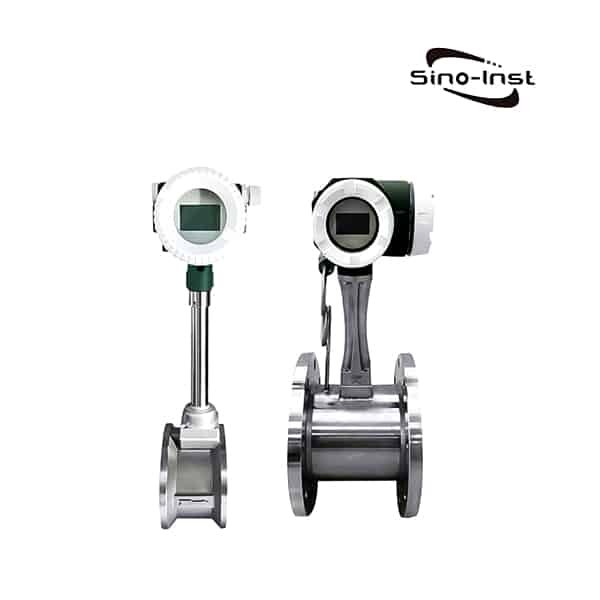
Vortex flow meter

Handles high-pressure gaseous ammonia in superheated lines. Needs external pressure and temperature compensation to convert volume to mass. Minimum Reynolds number of 10,000 means low flows drop out. Rugged, no moving parts, good for 250+ °C service where Coriolis is not rated. Upstream and downstream straight-pipe rules are strict — see our upstream and downstream straight pipe requirements for the 10D/5D layout on vortex.
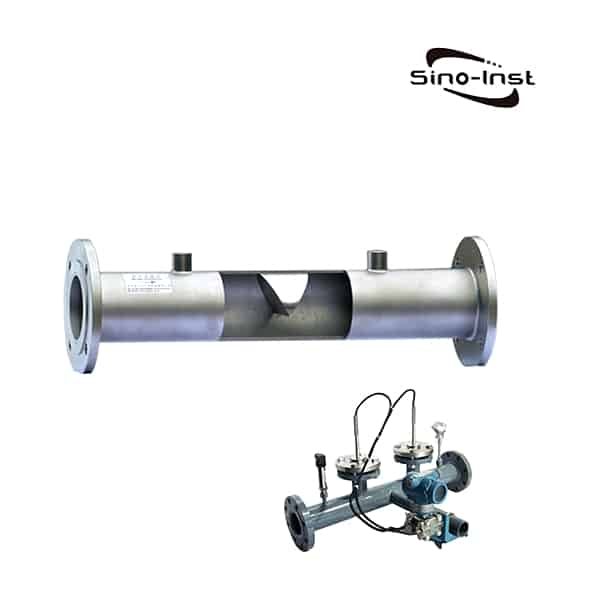
Differential-pressure (V-cone, orifice, Verabar)

Large-DN gaseous ammonia lines in fertilizer plants often use DP elements. V-cone handles dirty gas better than orifice. Accuracy ±1–2% of full scale; turndown limited to 4:1 without a smart DP transmitter. Needs separate pressure and temperature inputs to compute mass.

Magnetic (electromagnetic)

Does not work on anhydrous NH3 (too low conductivity). Works on aqueous ammonia (ammonium hydroxide), aqueous urea, and urea-ammonia blends used in SCR DEF systems. PFA lining is mandatory for corrosion resistance.

How to choose an ammonia flow meter

Work through these decisions in order. Skipping even one leads to a meter that does not fit the service.

  1. Phase: liquid, vapor, two-phase, or aqueous? Each demands a different meter category.
  2. Accuracy needed: custody transfer (±0.2%) drives you to Coriolis. Process control (±1%) opens the door to turbine, thermal, or vortex.
  3. Pressure and temperature: ammonia refrigeration runs at −40 °C; urea-ammonia plants run at 160 °C. Check the meter temperature spec carefully.
  4. Line size and flow range: match meter to flow velocity, not pipe DN. See 6-inch DN150 flow meter selection for guidance on larger lines.
  5. Materials: 316L stainless steel is standard. No copper, no brass, no aluminum in wetted parts. PTFE and Viton for seals. Soft seals for ammonia refrigeration must be certified for NH3 service (EPDM is acceptable; Buna-N is not).
  6. Hazardous area rating: ammonia is classified Group IIA in IEC, so most industrial certifications cover it. Confirm ATEX or IECEx zone rating on the nameplate.
  7. Output: 4–20 mA for standalone instruments, Modbus RS-485 for skid integration, HART for DCS diagnostics. For flow totalization, the meter must support pulse output or Modbus totalizer.

Related service: if you also need to measure ammonia gas concentration or leak detection, see the gas analyzers in our industrial gas flow measurement range — same housing platform, different sensor.

Where ammonia flow meters are used

  • Fertilizer production: urea, ammonium nitrate, and compound fertilizer plants meter anhydrous ammonia and process gas.
  • Industrial refrigeration: NH3 as refrigerant in cold storage, food processing, ice rinks, and district cooling.
  • SCR NOx reduction: aqueous ammonia or urea-ammonia injection into flue gas for power plant emission control.
  • Agricultural direct application: anhydrous NH3 injection into soil as a nitrogen source; high-flow, seasonal demand.
  • Chemical energy storage: emerging use of green ammonia as hydrogen carrier; high-purity, custody-transfer metering.
  • Semiconductor manufacturing: precursor gas flow control at low flow rates; thermal mass meters dominate.

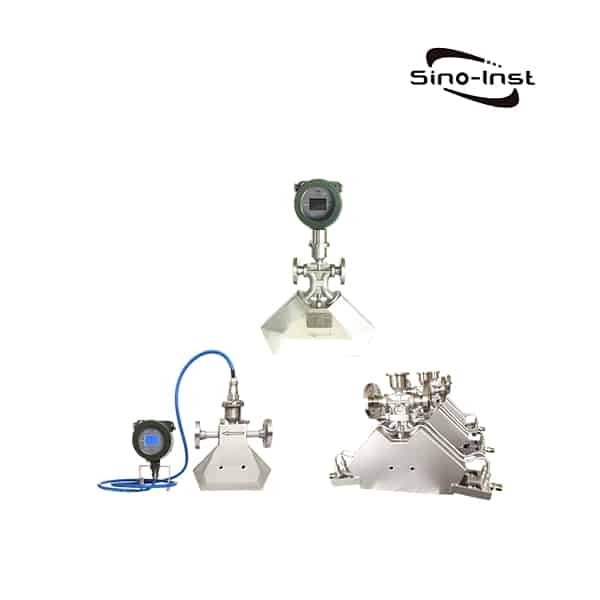
Triangle Coriolis Mass Flowmeter

Direct mass measurement for liquid anhydrous ammonia and custody-transfer duty. ±0.1% accuracy, 316L wetted parts, −50 °C to +150 °C. Phase-independent — handles occasional vapor flash without losing signal.

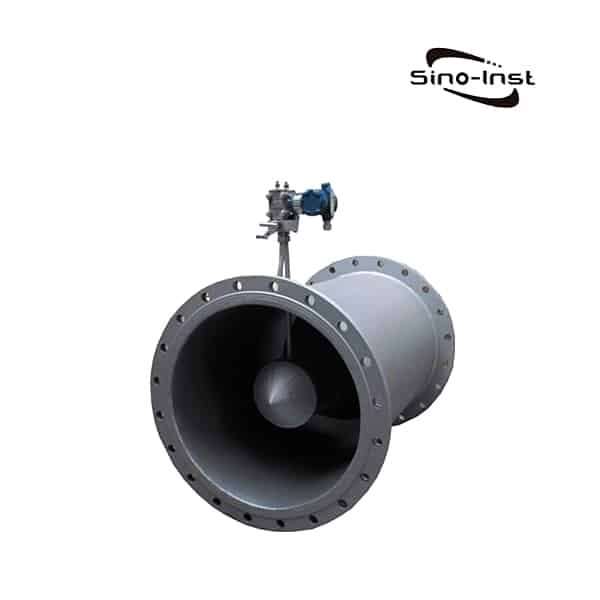
V-Cone Flow Meter

Low-maintenance DP element for gaseous NH3 in large-DN fertilizer and SCR lines. ±1% accuracy, excellent turn-down with smart DP transmitter, no moving parts, tolerates dirty gas.

Magnetic Stainless Steel Flow Meter

PFA-lined electromagnetic meter for aqueous ammonia (NH4OH) and urea-ammonia SCR injection. ±0.2% of rate, 100:1 turndown, no moving parts, no straight-run penalty past DN50.

FAQ

What flow meter is used for anhydrous ammonia?

A Coriolis mass flow meter is the standard choice for anhydrous liquid ammonia. It reads mass directly, is unaffected by phase flashing, and uses 316L stainless steel — fully compatible with NH3. For lower accuracy or OEM cost points, a stainless steel turbine with PTFE bearings is a valid alternative.

Why can’t a magnetic flow meter measure anhydrous NH3?

Magnetic flow meters need a conductivity above about 5 µS/cm to generate a signal. Anhydrous ammonia has essentially zero conductivity. Aqueous ammonia is highly conductive and a magmeter works perfectly on NH4OH, but not on pure NH3.

How do you meter ammonia gas flow?

For dry, single-phase NH3 vapor, use a thermal mass flow meter or a Coriolis. For large lines in fertilizer plants, a V-cone or Verabar DP element with pressure and temperature compensation computes mass from volume. Vortex meters work above Reynolds 10,000 but require external compensation.

What materials are compatible with ammonia?

316L stainless steel, PTFE, Viton, EPDM, and some grades of polypropylene are compatible with ammonia. Copper, brass, bronze, zinc, and aluminum all react with NH3 and must not be used in wetted parts. Seals should be EPDM or PTFE, never Buna-N.

What is the accuracy of an ammonia Coriolis flow meter?

Typical Coriolis accuracy on liquid ammonia is ±0.1% of reading over 10:1 turndown. For custody-transfer installations, calibration to ±0.05% is available by the manufacturer. Pressure and temperature do not affect accuracy because Coriolis reads mass directly.

Can one flow meter handle both liquid and gas ammonia?

Only Coriolis can. Because Coriolis measures mass, a calibrated meter reads correctly whether the tube is full of liquid or gas, as long as flow is single-phase through the measuring section. Volumetric meters (turbine, vortex, thermal) lose accuracy immediately on phase change.

Looking for a quote on an NH3 flow meter? Send your phase, pressure, temperature, flow range, and pipe size. Our engineering team will match a meter, confirm materials compatibility, and issue a specification sheet within 24 hours. For broader background on flow technologies before you decide, see what is a flow meter.

Request a Quote

Please enable JavaScript in your browser to submit the form

Pressure Transmitter Troubleshooting: 5-Fault Checklist & Loop Test

Updated May 26, 2026 | Sino-Inst Engineering Team

Most pressure transmitter troubleshooting calls trace to one of five things. A 4–20 mA transmitter with “no output” looks like a dead sensor, but it almost never is. In our field records, 80% of no-output reports come down to wrong wiring polarity, low supply voltage, an open loop, a clogged impulse line, or a damaged diaphragm. Work down this list in order and you will find the fault before opening the transmitter housing.

Contents

First 60 seconds: what to check before touching anything

Before any multimeter goes on the loop, rule out a control-system cause. 30% of reported transmitter failures are actually DCS tag problems or PLC analog card faults. Confirm scaling first — our pressure transmitter working principle page has the URL/LRL math used in tag setup.

  • Check the DCS tag: is the scale correct? A transmitter reading 50% shown as 0% is a tag fault, not a transmitter fault.
  • Check the analog input card: pull a second channel from the same card. If it also reads 0, the card is dead.
  • Check the 24 V power supply: measure DC at the marshalling panel, not at the PSU. Long cable runs drop 2–4 V at 20 mA loop current.
  • Look at the transmitter display: a local LCD showing pressure but the DCS showing zero means the loop is broken somewhere between the transmitter and the DCS input card.

Pull recent maintenance records. If another technician just swapped wiring, changed a fuse, or opened an isolation valve, that is your most likely cause.

The basic loop test — multimeter in series

Loop current tells you what the transmitter is actually putting out. A multimeter set to mA, wired in series, is the single most diagnostic tool you have.

  1. Set multimeter to DC mA, 200 mA range.
  2. Disconnect the positive loop wire from the transmitter + terminal.
  3. Put the multimeter red lead on the transmitter + terminal, black lead on the disconnected wire. Loop must stay unbroken.
  4. Read the current.
ReadingWhat it meansNext step
4.00 mA ±0.05Transmitter healthy, pressure at zeroCheck if that is plausible. If not, look at impulse line and diaphragm.
3.8–5 mA, unstableLoose terminal, moisture, or bad groundTighten terminals. Check for water in conduit. Verify shield grounded at one end only.
< 3.6 mAFailed low alarm — transmitter detects internal faultCheck local display for error code. Diaphragm, electronics, or calibration fault likely.
> 21 mAFailed high alarm — out-of-range or sensor shortCheck process pressure vs URL. Diaphragm may be over-ranged.
0 mANo loop — open circuit or no supplyGo to Fault 1 and Fault 2.

A working 2-wire transmitter must draw at least 4 mA to run its own electronics. If you see 0 mA, the transmitter itself is not even booted — the loop is open or the supply is too low. If the loop has to drive a 0–10 V PLC input downstream of the sense resistor, refer to our 4-20 mA to 0-10 V conversion guide for the matching resistor math.

Fault 1: Wiring reversed or open

Reversed polarity is the #1 cause of a just-installed transmitter reading zero. The transmitter has reverse-polarity protection on most models, so it does not blow — it just sits there drawing nothing.

  • Confirm + goes to transmitter +, — goes to transmitter −. Labels on the terminal block are authoritative, not the cable color.
  • Check conductor continuity end-to-end. Marshalling cabinet to field junction box to transmitter.
  • For 2-wire transmitters, there are only two terminals. For 4-wire units (powered separately), signal and power are on different pairs — do not confuse them.
  • For installation best practice, see our pressure transmitter installation guide.

Fault 2: Low supply voltage at the transmitter

Most 4–20 mA transmitters need a minimum of 10–16 V DC at the terminals to operate. The nominal 24 V supply at the control room can drop below that by the time it reaches a field transmitter at the end of a 400 m cable loop with a 250 Ω sense resistor.

Calculate minimum supply voltage:

V_supply_min = V_transmitter_min + (0.020 A × (R_sense + R_cable + R_barrier))

For a 250 Ω sense resistor, 25 Ω cable loop, IS barrier at 300 Ω, and a transmitter needing 12 V:

V_supply_min = 12 + 0.020 × (250 + 25 + 300) = 12 + 11.5 = 23.5 V

A 22 V supply on that loop will leave the transmitter cold. Swap to a 24 V or 28 V supply, or move the sense resistor closer to the transmitter. For HART communication, keep at least 250 Ω in the loop — see our HART pressure transmitter guide for the full loop math.

Fault 3: Blocked impulse line or closed isolation valve

A perfectly healthy transmitter will read 4 mA if the process pressure never reaches the diaphragm. Blocked impulse lines are the #1 process-side cause of flat output.

  • Is the manifold isolation valve open? Walk the line from the process tap to the transmitter and touch every valve.
  • Is the impulse line plugged? Crystallization, scale, and wax plug lines over time. A hot-water flush through the tap usually clears it.
  • Is there trapped gas in a wet leg or trapped liquid in a dry leg? Both sides of a DP transmitter must be the phase the installer intended. Our DP transmitter installation guide covers impulse-line filling procedures.
  • On a diaphragm seal transmitter, is the capillary oil leaked out? Touch the face of the remote seal: a sunken diaphragm means fill fluid is gone and the transmitter needs factory service.

Fault 4: Damaged or saturated diaphragm

An over-ranged diaphragm reads a constant upper limit (20 mA or higher) regardless of real pressure. A cracked or stretched diaphragm reads constant low or drifts with temperature.

  • Bench test: remove the transmitter, apply a known pressure with a hand pump, and watch output. A linear 4–20 mA response across 0–100% means the sensor is good.
  • Stuck at 20+ mA: diaphragm over-ranged, or electronics stuck in failed-high state. Most transmitters recover after a pressure release and a power cycle.
  • Stuck at 4 mA, no response to pressure: diaphragm mechanically damaged or the pressure sensing element is shorted internally. Replace the transmitter or send for repair.
  • Reading drifts with ambient temperature: fill fluid has migrated or the sensing diaphragm has permanent deformation. Replace.

Fault 5: Drifted zero, failed electronics

A transmitter that reads a steady 6–8 mA with no process pressure applied is usually alive but with drifted zero. This is fixable in the field with a HART communicator or via the local zero push-button.

  1. Isolate the transmitter from process pressure.
  2. Vent both sides of a DP transmitter to atmosphere (open the equalizer valve on the manifold).
  3. Trigger a zero-trim — via HART, the local button, or the DCS asset management software.
  4. Check that output is now 4.00 mA ± 0.02.
  5. If zero-trim does not hold, the electronics are drifting. Replace.

Do not confuse zero drift with span drift. Zero drift is a constant offset at zero pressure. Span drift shifts the 20 mA endpoint. Both are trimmable through the transmitter menu, but persistent drift after trimming means the sensor is degrading and the unit is near end-of-life. For a full calibration procedure with deadweight tester or hand pump, see our pressure transmitter calibration walkthrough.

Replacement options

Process Industrial Pressure Transmitter

General-purpose 4–20 mA with HART. ±0.075% accuracy, 10-year stability. Direct drop-in replacement for legacy Rosemount 3051 and Yokogawa EJA loops.
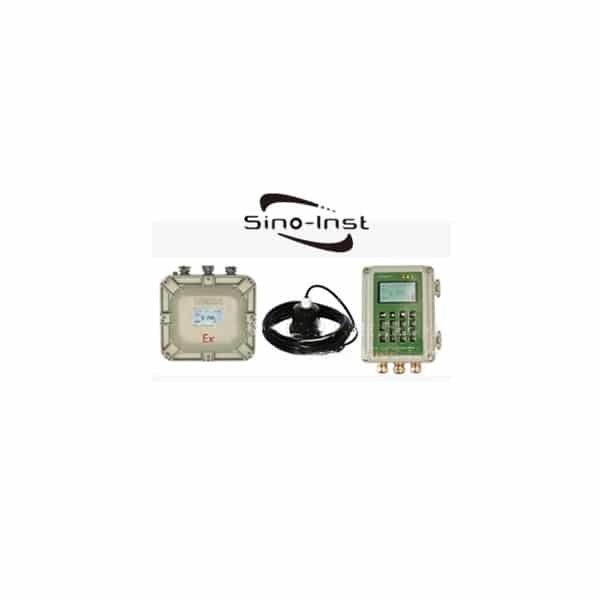
SMT3151 TGP Gauge Pressure Transmitter

Compact 2-wire gauge pressure unit for utilities and OEM use. ±0.1% accuracy, 0.4 kPa to 42 MPa range, IP67 housing. Fast zero-trim via magnetic button.
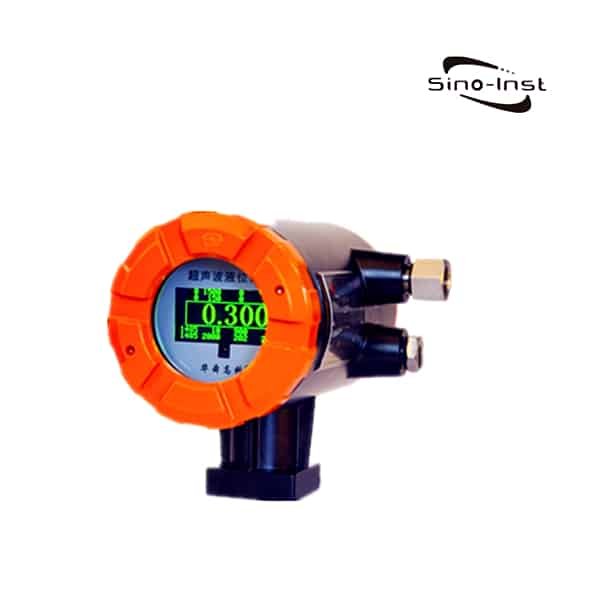
Diaphragm Seal Pressure Transmitter

Flush-flanged remote seal for viscous, slurry, or high-temperature service. Eliminates impulse-line blockage. 316L wetted parts, PTFE option, capillary lengths to 10 m.

FAQ

How do you troubleshoot a faulty pressure transmitter?

Start with the loop, not the transmitter. Put a multimeter in series and read the mA: 0 mA means open circuit or no power; 4 mA at zero process pressure means the transmitter is healthy but the impulse line may be blocked; >21 mA means a failed-high alarm. Walk the 5-fault sequence above (wiring, voltage, impulse line, diaphragm, drift) before opening the transmitter housing.

What does a 20 mA output mean when there is no pressure?

The transmitter has entered a failed-high alarm state. This happens when the sensor detects an internal fault — over-ranged diaphragm, failed ADC, or memory corruption. Cycle power to clear transient faults. If 20 mA persists at zero pressure, replace the transmitter.

How do I test a 4-20mA pressure transmitter with a multimeter?

Set the multimeter to DC mA (200 mA range), break the loop at the + terminal, and insert the meter in series. The multimeter becomes part of the current path. You should read 4 mA at zero pressure and 20 mA at full scale. Never put a multimeter in parallel with a 4–20 mA loop — it will short the signal to ground.

Can low voltage damage a 4-20mA transmitter?

Low supply voltage does not damage the transmitter, but it prevents normal operation. Below the minimum operating voltage (typically 10–12 V at the terminals), the transmitter either does not boot or outputs an unstable current. Fix the supply; the transmitter will resume normal service.

How often should a pressure transmitter be recalibrated?

Annual recalibration is standard for custody transfer and safety-critical loops. For general process control, 3–5 years is typical if the transmitter has not been exposed to over-range events, temperature cycling beyond spec, or corrosive service. Trend the zero drift year over year — if it is accelerating, shorten the interval.

Still stuck on a 4–20 mA loop that reads wrong? Send us the transmitter tag, loop wiring diagram, and the current DCS reading. Our engineers will walk through the fault tree with you and recommend a replacement unit if yours is end-of-life. If you also need a refresher on instrument units, our common units of pressure page covers psi/bar/kPa cross-reference.

Request a Quote

Please enable JavaScript in your browser to submit the form

Flow Meter Straight Length Requirements by Type, with ISO 5167 Tables

Contents

Why Velocity Profile Decides the Required Straight Run

Every flow meter that infers volumetric flow from a velocity measurement assumes a fully developed turbulent velocity profile — a symmetric paraboloid with the peak at the pipe centerline. Anything that disturbs that profile — an elbow, valve, reducer, pump — introduces swirl and asymmetry that biases the reading by several percent. The fix is straight pipe: enough length downstream of the disturbance for friction at the wall to re-symmetrize the flow.

How much straight pipe depends on what the meter actually senses. A magnetic flowmeter integrates velocity across the whole pipe cross-section and tolerates moderate asymmetry. A vortex meter watches a single shedding point and dies on swirl. A Coriolis tube measures mass directly and does not care about profile at all. The numbers below come from the manufacturer manuals and ISO 5167.

Straight Length by Flow Meter Type

Meter typeUpstreamDownstreamReason
Coriolis (mass)0 D0 DMeasures mass via tube vibration; profile irrelevant
Magnetic (magmeter)5 D2–3 DIntegrates velocity across full cross-section
Ultrasonic, multi-path inline10 D5 DPath averaging tolerates moderate distortion
Ultrasonic, clamp-on retrofit20 D5 DTwo-path cannot compensate for swirl
Vortex shedding15–25 D5 DSingle shedding point destroyed by swirl
Thermal mass (gas)15 D5 DSingle insertion point; needs symmetric profile
Turbine10 D5 DRotor balance depends on profile uniformity
Orifice plate10–44 D4–7 DSee ISO 5167-2 (β-dependent)
Venturi tube5–10 D4 DSmooth contour forgives some distortion
V-Cone / averaging pitot0–3 D1 DBuilt-in flow conditioning

D is the pipe inside diameter. A 200 mm magmeter needs 1.0 m upstream and 400–600 mm downstream — a manageable footprint. A 200 mm vortex meter in the same line needs 3–5 m upstream and 1 m downstream. The vortex meter often loses on installation cost alone for retrofit jobs. For the legacy general rule on 10D/5D, see our companion guide on upstream and downstream straight pipe.

ISO 5167 Lengths for Differential Pressure Elements

Differential pressure elements — orifice plates, nozzles, Venturi tubes — have published straight-length tables in ISO 5167 that vary with β (throat-to-pipe diameter ratio). Excerpt for a single 90° elbow upstream of an orifice plate:

βUpstream (D)Downstream (D)
0.20104
0.40145
0.50185
0.60266
0.67367
0.75447

Higher β means a larger orifice bore relative to pipe size, which keeps the discharge coefficient under tighter tolerance — but only if the velocity profile is undisturbed. Pick a smaller β (say 0.45 instead of 0.65) and the straight-pipe budget drops dramatically. For Venturi tubes the numbers are smaller — 5 to 10 D upstream depending on the disturbance type — because the smooth convergent cone tolerates more profile asymmetry. See our deeper guide on the Venturi tube for the geometry and standards reference.

Upstream Disturbance Multipliers

The straight-length table above assumes one 90° elbow upstream. Other disturbances need more:

  • Two 90° elbows in the same plane: 1.5× the base value
  • Two 90° elbows in perpendicular planes: 2× the base (severe swirl)
  • Reducer (2D long, concentric): 0.5× the base value
  • Expansion (2D long): 1.0× the base value
  • Fully open gate valve: 1.0× the base value
  • Half-open globe or ball valve: 2–3× the base value
  • Pump discharge (centrifugal): 2× the base value

The dominant offender is two elbows out of plane. The first elbow creates a centerline shift; the second adds swirl on top. Even a vortex meter that gets 25D upstream of a single elbow may need 40–50D after two perpendicular elbows. A common field fix is to insert a flow conditioner in the upstream straight section — which buys back roughly half the required length.

Flow Conditioners as a Compensation Strategy

When the available straight run is half what the meter demands, install a flow conditioner upstream of the meter and downstream of the disturbance. Three common types:

  • Tube bundle (19-tube or 7-tube): kills swirl, restores symmetric profile in 4–5D. Adds 1–2 kPa pressure drop.
  • Etoile or AMCA vane: radial vanes break swirl in 2–3D. Lower pressure drop than tube bundle but less effective on asymmetric profiles.
  • Perforated plate (Zanker, Mitsubishi, NOVA): creates jets that recombine into symmetric profile in 8D. Standard for fiscal custody-transfer orifice metering per AGA-3.

The conditioner does not eliminate the straight-pipe budget. It compresses it. A vortex meter that would need 25D upstream of an elbow can be installed with 8D + a 1D Zanker plate + 4D, total 13D. Pressure drop is the trade — 5–20 kPa added at typical flows. For DP-element math underneath all of this, see our DP transmitter explainer.

Measuring Straight Length the Right Way

Two field-measurement mistakes lose money:

  • Counting from the wrong reference. Upstream length is measured from the downstream face of the disturbance (end of elbow weld, downstream of valve flange) to the front face of the meter primary element. Not centerline to centerline.
  • Ignoring intermediate fittings. A tee or instrument tap inside the “straight” pipe section is a new disturbance. Restart the count.

Downstream length runs from the back face of the meter to the next disturbance. Most meters care less about downstream than upstream, but a too-short downstream run can drive cavitation back into the meter on liquid service. For installations where there is genuinely no room, our DP transmitter installation guide covers the impulse-line solutions that DP elements can use in tight spaces.

Common Mistakes That Wreck Accuracy

MistakeTypical biasFix
Vortex meter installed 5D after an elbow (needs 25D)5–15% reading errorAdd 20D or install flow conditioner
Orifice β = 0.7 with only 10D upstream (table says 36D)3–8% over-readReduce β to 0.45 or move meter
Ultrasonic clamp-on right after a pump (needs 20D + conditioner)2–5% drift, swirl-dependentUse inline spool-piece ultrasonic instead
Tee inside the “straight” sectionRandom 1–4% noiseReroute tee or restart length count from tee
Pipe diameter at flange not matching meter boreEdge step bias 2–4%Use a 2D concentric reducer 5D upstream
Reading from centerline to centerline instead of weld facesApparent compliance, real 10–15% under-lengthField-measure from disturbance face

For a quick reference on a related rule-of-thumb question — what is K-factor and why straight-pipe affects it — see our piece on flow meter K-factor.

Short-Run Flow Meter Alternatives

Magnetic Flow Meter

DN10 to DN3000 | 5D up / 3D down | ±0.5% — tolerates short straight runs on conductive liquids: water, slurry, acids.

Vortex Flow Meter

DN15 to DN300 | needs 15–25D up / 5D down | ±1% — steam, gas, condensate where Coriolis is too expensive.

Wedge Flow Meter

DN15 to DN1200 | needs only 4–6D up | ±1% — heavy oil, slurry, dirty service where orifice plate plugs.

For installations where straight pipe is truly impossible — closely spaced manifolds, retrofit jobs in cramped equipment skids — Coriolis mass flow is the safest answer. Send pipe size, fluid, flow range, available straight length, and disturbance type (elbow, valve, pump) to our engineering team via the form below and we will spec a meter for the geometry you have.

FAQ

How much straight pipe does a magnetic flow meter need?

Per the manufacturer manuals: 5 pipe diameters upstream and 2 to 3 pipe diameters downstream from the nearest disturbance. A 200 mm magmeter needs about 1.0 m straight upstream and 400–600 mm downstream. Magnetic flow meters tolerate short runs because the electrode array averages velocity across the full pipe cross-section.

What is the straight length requirement for a vortex flow meter?

15 to 25 pipe diameters upstream depending on the disturbance type, and 5 diameters downstream. A single elbow is 15D, two elbows out of plane is 25D, half-open valve is 30D+. Vortex meters react badly to swirl because they sense vortex shedding at a single bluff body and any swirl shifts the shedding frequency.

Do Coriolis flow meters need straight pipe?

No. Per ISO 10790, Coriolis meters have no straight-pipe requirement for accuracy because they measure mass directly through tube vibration and are insensitive to velocity profile distortion. The only installation rule is to keep the tubes full of liquid (no air pockets, no entrained gas).

How do you measure straight pipe length for a flow meter?

From the downstream face of the disturbance (elbow weld face, valve flange) to the front face of the meter primary element. Not centerline to centerline. Any intermediate fitting — tee, tap, reducer — restarts the count. Downstream length is measured from the back face of the meter to the next disturbance.

Can a flow conditioner replace straight pipe?

It can reduce the required straight length by 40–60%, not eliminate it. A 19-tube bundle or Zanker plate installed downstream of a disturbance restores a symmetric velocity profile in 4–8D, so a vortex meter that would need 25D upstream of an elbow can run on 8D + conditioner + 4D. The trade is 5–20 kPa added pressure drop at typical flows.

Request a Quote

Please enable JavaScript in your browser to submit the form

Ultrasonic Level Transmitter Installation: Dead Zone, Beam Angle & 5-Step Mounting

Contents

Why Geometry Decides Accuracy

An ultrasonic level transmitter sends a pulse, listens for the echo, multiplies travel time by the speed of sound, and divides by two. The math is simple. What goes wrong in the field is almost always geometry: the sensor mounted too close to the maximum liquid level, too close to a tank wall, aimed at an agitator, or staring into a foam blanket. Get the install right and accuracy lands inside ±0.25% of range; get it wrong and the reading drops out or sticks at one value. For comparison with other tank gauging methods, see our overview of ultrasonic tank level sensors.

This guide walks through the geometry rules — dead zone, beam angle, clearance, false echoes — and finishes with a six-step calibration procedure that works for any 40, 75, or 120 kHz transducer. For a deeper background on how the sensor itself works, see our explainer on ultrasonic level transmitters.

Blanking Distance: Sizing the Dead Zone

The blanking distance (also called the dead zone or near zone) is the volume directly in front of the transducer where no measurement is possible. The transducer needs time to stop physically vibrating after each transmit pulse before it can listen for the returning echo. Read inside the blanking distance and you get the transducer’s own ring-down, not the liquid surface.

FrequencyTypical rangeTypical blankingBeam angle
40 kHz0.3 – 8 m0.3 m (12 in)10°–12°
75 kHz0.25 – 5 m0.25 m (10 in)8°–10°
120 kHz0.2 – 3 m0.15 m (6 in)6°–8°
200 kHz0.1 – 1.5 m0.1 m (4 in)5°–6°

Sizing rule: the maximum liquid level must sit at least one blanking distance below the transducer face. For a 40 kHz sensor with 300 mm blanking installed on a 6 m tank, the highest accepted level is 6.0 − 0.3 = 5.7 m. Operators usually add another 100–200 mm of safety margin because waves and turbulence push the apparent surface upward.

Five-Step Mounting Procedure

  1. Confirm the mounting flange location. The sensor face must be at least one blanking distance above the highest expected level. For roof-mounted installs on closed tanks, use the NPT or flange already specified for the model. Hand-tighten threaded sensors — overtightening cracks the housing.
  2. Verify perpendicularity. The transducer face must aim straight down within ±2°. A 1 m offset at 5° tilt loses 70% of return signal strength. Use a small bubble level on the threaded boss before final tightening.
  3. Check clearance to the nearest wall or fitting. Half-beam-angle clearance is the minimum (see calculation in next section). On a 6 m tank with a 40 kHz sensor, that means staying 0.6 m from the wall.
  4. Cable the transducer with shielded twisted pair. Run separately from variable-frequency-drive cables to avoid EMI pickup. Ground the shield at the controller end only.
  5. Energize and check the empty echo. With the tank empty, the displayed level should read maximum range. If the screen shows “lost echo,” the sensor is either aimed at a fitting or above its rated range.

Beam Angle and Clearance Math

The ultrasonic beam spreads as a cone. The half-angle θ/2 gives the minimum clearance to any wall, ladder, or pipe inside the tank. The footprint radius at a sensing distance d is:

r = d × tan(θ/2)

For a 75 kHz sensor with a 9° total beam (4.5° half angle) at 4 m range:

r = 4 × tan(4.5°) = 4 × 0.0787 = 0.315 m

So nothing — ladder, baffle, internal nozzle, agitator shaft — can be within 315 mm of the beam axis at 4 m below the sensor. Anything inside that cone returns an echo that the transmitter cannot distinguish from the liquid surface. Most false-echo problems trace back to engineers using only the centerline distance and forgetting the cone.

Avoiding False Echoes from Internals and Foam

Sources of false echo, ranked by how often we see them:

  • Internal ladders or piping inside the cone. Either reposition the sensor or program a “ignore echo” zone at the offending distance.
  • Foam or floating crust. Standard ultrasonic does not see through more than 50 mm of dense foam. Switch to guided wave radar or a stilling well if foam is persistent.
  • Agitator turbulence. Mount at least one tank diameter away from the impeller swirl, or use a stilling well (seamless PVC pipe, 100 mm diameter, with a ¼” vent hole drilled within the blanking distance and ¼” holes at the bottom for liquid flow).
  • Dome-top tanks. Echoes bounce around the dome and arrive late. Never mount in the center of a dome — offset by at least one tank radius.
  • Steam, dust, or temperature gradients. All change the speed of sound and bias the level reading. A 50 °C temperature drift introduces about a 7% level error if not compensated.

For deep tanks with internal obstructions, our guide on stilling well design covers the hole pattern math and pipe-sizing rules that also apply to ultrasonic sensors.

Outdoor Installation: Sun, Wind, Rain

Outdoor installations punish ultrasonic sensors three ways. Direct sunlight on the transducer face raises the sensor body 10–20 °C above ambient and shifts the speed-of-sound compensation. Wind blows the sound wave off centerline above 30 km/h, causing intermittent lost echoes. Rain creates a curtain of point reflectors between sensor and liquid. For diesel and fuel tanks specifically, see our notes on checking level in underground tanks.

Mitigations: a 200 × 200 mm aluminum sunshade mounted 100 mm above the sensor cuts the thermal swing in half. A short PVC stilling well (4× sensor face diameter, 1 m long, vented at the top) handles all three problems together. For wastewater and chemical tank applications, see the non-contact liquid level sensor guide for material compatibility notes.

Commissioning: 6 Calibration Steps

  1. Set sensor type. In the transmitter menu, pick the actual transducer model so dead zone, max range, and beam angle defaults load correctly.
  2. Enter tank height (zero reference). Measure with a steel tape from the sensor face to the tank floor. Enter this as the 4 mA point.
  3. Enter the empty distance. Distance from sensor face to the lowest expected liquid level. This usually equals tank height minus the desired low alarm volume.
  4. Enter the full distance. Distance from sensor face to the highest expected liquid level (which must be at least one blanking distance below the sensor). Enter as the 20 mA point.
  5. Run the echo map. Most modern transmitters scan the empty tank once to record fixed obstruction echoes for masking. Run this with the tank fully drained.
  6. Verify with a wet test. Fill the tank to two known levels (typically 25% and 75%) and compare the displayed value against a sight glass or dipstick. Adjust 4 mA / 20 mA span if error exceeds ±0.5% of range.

For 4-20 mA loop verification math, our piece on how transmitters generate the 4-20 mA signal covers loop power and scaling.

Common Installation Mistakes

MistakeSymptomFix
Sensor below blanking distance from max levelFrozen reading at max range, surge near fullRaise mounting flange or switch to higher-frequency sensor
Mounted in center of dome topErratic reading, jumps every few secondsOffset to one tank radius from center
Cable run beside VFD cablePeriodic noise spikesReroute through separate conduit, ground shield once
No temperature compensationSteady drift with ambient or process temperatureEnable built-in temp comp or wire external RTD
Aimed at agitatorLost echo or wrong levelAdd stilling well or relocate
Overtightened threaded bossCracked housing, IP66 failureHand-tight only; teflon tape if needed for seal

For the pressure-based alternative (when foam or steam rule out ultrasonic), see our companion guide on DP transmitter installation.

Ultrasonic Level Sensors from Sino-Inst

HS-2000 External Tank Level Sensor

External-mounted | non-invasive | 0–10 m range | ±0.5% — for closed pressurized tanks where internal mounting is not possible.

807 Low-Temperature Level Sensor

–40 to +80 °C | 0–6 m | IP68 | 4-20 mA — for outdoor and refrigerated tank applications where standard ultrasonic struggles.

Ultrasonic Clamp-on Flow Meter

Transit-time | clamp-on | DN15–DN6000 | ±1% — companion ultrasonic technology for pipe flow when tank level isn’t the answer.

For sizing, sensor selection, and a tank-specific install drawing, contact our engineering team using the form below. Send the tank height, diameter, contents, mounting nozzle size, and any photos of the top of the tank — we typically reply with a recommended sensor and mounting plan within one business day.

FAQ

What is the blanking distance of an ultrasonic level transmitter?

The blanking distance, or dead zone, is the area directly in front of the transducer where no measurement is possible because the transducer is still vibrating from the transmit pulse. Typical values: 100 mm for a 200 kHz sensor, 300 mm for a 40 kHz sensor. The maximum liquid level must sit at least one blanking distance below the sensor face.

How high above the liquid should an ultrasonic level sensor be mounted?

At a minimum, one blanking distance above the highest expected liquid level. For a 40 kHz sensor (300 mm blanking) on a tank that fills to 5.7 m, mount the sensor at 6.0 m. Add 100–200 mm safety margin for surface waves and turbulence.

Why does my ultrasonic level transmitter show “lost echo”?

Three most common causes: the sensor is tilted more than 2° off perpendicular, foam or floating crust is blocking the return echo, or an internal fitting (ladder, agitator, nozzle) sits inside the beam cone. Check perpendicularity with a bubble level first, then map the cone footprint for obstructions.

Can ultrasonic level transmitters work outdoors?

Yes, with three precautions: a sunshade above the transducer to limit thermal drift, a short stilling well to block wind and rain, and ensuring the temperature compensation is enabled (a 50 °C ambient swing introduces about 7% level error without compensation).

How do I calibrate an ultrasonic level transmitter?

Six steps: (1) set sensor model, (2) enter tank height as the 4 mA reference, (3) enter empty distance, (4) enter full distance as the 20 mA point, (5) run the echo map with the tank drained to mask fixed obstructions, (6) fill to a known level and verify against a sight glass — adjust span if error exceeds ±0.5% of range.

Request a Quote

Please enable JavaScript in your browser to submit the form

Venturi Tube Working Principle, Bernoulli Math & ASME Specs

Contents

What a Venturi Tube Does

A venturi tube is a short pipe section with a narrowed middle, used to measure fluid flow rate by sensing the pressure drop across the constriction. The device was described by Italian physicist Giovanni Battista Venturi in 1797 and remains one of the most accurate primary elements for measuring water, steam, oil, and gas flow.

Three sections do all the work: a converging inlet that accelerates the fluid, a cylindrical throat where pressure reaches its lowest value, and a diverging outlet that recovers most of the kinetic energy as static pressure. Two pressure taps — one upstream, one at the throat — feed a differential pressure transmitter that outputs a 4–20 mA signal proportional to the square root of flow.

You will see venturi tubes in municipal water mains, power plant feedwater lines, chiller plants, custody-transfer crude oil headers, and wherever pumping cost makes the pressure loss of an orifice plate unacceptable.

The Venturi Effect and Bernoulli Equation

The physics is one equation. For an incompressible, steady, frictionless flow along a streamline, Bernoulli’s equation between the upstream tap (section 1) and the throat (section 2) gives:

P₁ + ½ρv₁² = P₂ + ½ρv₂²

Combine with continuity (A₁v₁ = A₂v₂) and you get the working form most engineers use day-to-day:

Q = Cd · A₂ · √[ 2·ΔP / (ρ · (1 − β⁴)) ]

Where Q is volumetric flow (m³/s), A₂ is throat area (m²), ΔP is the measured pressure differential (Pa), ρ is fluid density (kg/m³), β is the throat-to-pipe diameter ratio (d/D), and Cd is the discharge coefficient — typically 0.984 for a classical Venturi with machined convergent and rough cast iron throat per ISO 5167-4. The β⁴ term in the denominator is the velocity-of-approach correction; you cannot ignore it when β > 0.3.

Anatomy of a Classical Venturi Tube

Three sections by length and angle:

  • Convergent cone: total included angle 21° ± 1°. Length about 2.7 × (D − d).
  • Throat: length equal to the throat diameter d. Two diametrically opposed pressure taps (or four equispaced taps connected to a piezometer ring) sit at the midpoint.
  • Divergent cone: total included angle 7° to 15°. Shorter angles recover more pressure but add cost and weight; 7° is the textbook value for maximum recovery.

The upstream pressure tap sits at a distance of ½D from the start of the convergent section. This is the geometry of the “classical” Venturi tube as defined in ASME MFC-3M. Get the cone angles wrong and the discharge coefficient drifts outside the standard’s ±0.7% tolerance, requiring individual calibration.

Five Venturi Tube Designs by Geometry

DesignConstructionTypical βCdUse case
Classical machinedBronze or stainless, machined convergent0.4–0.750.995Lab, custody transfer
Classical rough castCast iron, as-cast convergent0.3–0.750.984Large water mains
Classical welded sheetFabricated steel, β-ring throat0.4–0.70.985Power plant feedwater
Short-form (Herschel)Shortened divergent, 21° angle0.4–0.70.97–0.99Tight installations
RectangularFlat-sided, non-circularvaries0.95–0.99HVAC ducts, open channels

The short-form (Herschel) Venturi trades 5–10% of pressure recovery for half the lay length. That tradeoff often makes sense in retrofit jobs where there is no room for a 5-meter classical tube. The rectangular variant shows up in HVAC supply ducts and water canals where a circular flow element does not fit. For more on duct-mounted DP sensing, see our guide on static vs dynamic pressure.

Worked Flow Calculation: From ΔP to Q

Water at 20 °C flows through a 200 mm classical Venturi with a 100 mm throat. The DP transmitter reads 25 kPa. What is the flow rate?

  • D = 0.200 m, d = 0.100 m, so β = 0.5
  • A₂ = π × (0.100)² / 4 = 0.007854 m²
  • ρ = 998 kg/m³ (water at 20 °C)
  • ΔP = 25,000 Pa
  • Cd = 0.984 (rough cast convergent per ISO 5167-4)
  • 1 − β⁴ = 1 − 0.0625 = 0.9375

Plug in: Q = 0.984 × 0.007854 × √[ (2 × 25,000) / (998 × 0.9375) ] = 0.984 × 0.007854 × √(53.45) = 0.984 × 0.007854 × 7.311 = 0.0565 m³/s ≈ 203 m³/h.

Throat velocity v₂ = Q / A₂ = 0.0565 / 0.007854 = 7.2 m/s, which is well inside the 1.5–10 m/s sweet spot for Venturi tubes. Below 1.5 m/s, DP gets noisy. Above 10 m/s, you start seeing cavitation risk on the throat for liquids. For the DP side of the math, our explainer on how DP transmitters work covers signal conditioning.

Venturi vs Orifice Plate vs Flow Nozzle

ParameterClassical VenturiOrifice PlateFlow Nozzle
Permanent pressure loss5–20% of ΔP40–95% of ΔP30–80% of ΔP
Discharge coefficient0.984–0.9950.60–0.620.93–0.99
Accuracy (uncalibrated)±0.7%±0.6%±1.0%
Turndown ratio3:1 to 5:13:1 to 5:13:1 to 4:1
Straight pipe upstream5–10 D10–44 D10–30 D
Capital cost (200 mm)$$$ (high)$ (low)$$ (mid)
Best forLarge lines, slurriesClean fluids, retrofitSteam, high temperature

The orifice plate wins on price and is fine when you do not care about pump head. The Venturi wins when permanent pressure loss costs real money — a 1000 mm water main saving 20 kPa year-round is worth tens of kilowatts of pump power. Flow nozzles fit in between, popular for high-temperature steam where orifice edge wear becomes a calibration problem. For thicker comparison content, see our piece on flow meter K-factor.

ASME MFC-3M and ISO 5167-4 Standards

Two documents govern Venturi tube design and calibration:

  • ASME MFC-3M-2004: “Measurement of Fluid Flow in Pipes Using Orifice, Nozzle, and Venturi.” Defines convergent angle 21° ± 1°, divergent angle 7° to 15°, throat surface roughness, and the Cd equations.
  • ISO 5167-4:2022: “Measurement of fluid flow by means of pressure differential devices — Part 4: Venturi tubes.” Sets the diameter range 50 mm ≤ D ≤ 1200 mm and Reynolds number range 2×10⁵ ≤ Re ≤ 2×10⁶ for uncalibrated use.

Outside those bounds — small lines, low flows, high-temperature gas, or β below 0.3 — you cannot use the tabulated Cd. The tube must be wet-calibrated on a flow rig traceable to NIST. Calibration adds about $3,000–$8,000 to a 200 mm classical Venturi.

Installation: Straight Runs and Tap Orientation

The Venturi is forgiving compared with an orifice plate, but it still needs straight pipe:

  • 5 D upstream of a single 90° elbow
  • 10 D upstream of two elbows in perpendicular planes
  • 20 D upstream of a partly closed valve
  • 4 D downstream before any disturbance

Pressure tap orientation depends on the fluid. For clean liquids, taps at 3 and 9 o’clock (horizontal pipe). For gas with possible condensate, taps at 12 o’clock. For steam, taps at 3 and 9 with condensate pots installed below. Get this wrong and you get either a slugged transmitter or a permanently water-logged impulse line. Our DP transmitter installation guide covers impulse line slopes and 3-valve manifold sequencing.

For straight-pipe rules of thumb on every meter type, see our flow meter straight pipe guide.

Pressure Recovery: Venturi’s Energy Advantage

The diverging cone is where Venturi tubes earn their cost. By gradually expanding the flow from throat to pipe diameter at a 7° included angle, the fluid decelerates without turbulent separation and most of the kinetic energy converts back to static pressure. Typical permanent pressure loss is 10% of the measured ΔP at β = 0.5, dropping to 5% at β = 0.7. Compare that with an orifice plate at the same β, which dumps 70–95% of ΔP as friction loss.

Over a year, a 600 mm Venturi at 0.5 m/s saving 15 kPa of pump head represents roughly 4 kW of continuous pump power. At $0.12/kWh that is about $4,200 per year — payback on the Venturi premium often inside 2 years. This is the math behind every chilled water plant retrofit replacing orifices with Venturis.

Cleaning Venturi Tubes (Industrial + BBQ Grill)

Two completely different cleaning jobs share the name. The industrial Venturi flow meter rarely needs cleaning if the fluid is clean; for slurries or scaling water, a yearly inspection and high-pressure rinse of the throat are normal. Pressure taps are the failure point — they plug with debris and bias the reading low. Most modern Venturis include flush connections on the tap legs.

Gas grills are the other context. Each burner has a small Venturi tube where propane or natural gas accelerates and pulls in primary air. Spiders love these tubes; webs and egg sacs block airflow and produce yellow flames or backfiring. To clean a grill Venturi: shut off gas, remove the burner, slide the Venturi off the orifice spud, push a pipe cleaner or bottle brush through the tube, blow out with compressed air, reassemble. Inspect every spring before first use.

Venturi Flow Meters from Sino-Inst

Venturi Flow Meter

DN50 to DN1200 | β 0.4–0.75 | ±0.5% — classical and short-form geometries for water, oil, gas service.

Verabar Flow Meter

Averaging pitot | hot tap insertion | low pressure loss — alternative to Venturi for large pipes with retrofit constraints.

V-Cone Flow Meter

Conditioning DP element | 0–3D straight run | tolerates swirl — compact replacement for Venturi in tight installations.

For sizing help or a quotation on any of these flow elements, contact our engineering team using the form below. Provide pipe size, fluid, design flow, and operating pressure-temperature; we typically reply within one business day.

FAQ

What is a venturi tube used for?

Measuring flow rate by sensing the pressure drop across a constricted throat. Common applications are municipal water, power plant feedwater, chilled water HVAC, oil custody transfer, and grill burner air entrainment.

How does a venturi tube work?

The fluid accelerates through a converging cone, causing static pressure to drop in the throat (Bernoulli’s equation). A DP transmitter reads the pressure difference between upstream and throat taps; volumetric flow is proportional to the square root of that differential.

How do you clean venturi tubes on a gas grill?

Shut off the gas, lift out the burner, slide the Venturi tube off the orifice spud, push a long-handled bottle brush or pipe cleaner through the tube to remove spider webs and debris, blow clean with compressed air, and reassemble. Inspect every spring before the first cookout.

What is the difference between a venturi tube and an orifice plate?

Both create a differential pressure for flow measurement. A Venturi recovers most of the pressure (5–20% permanent loss) thanks to its diverging cone; an orifice plate dumps 40–95% as turbulent loss. Venturi costs 5–10× more but pays back in pump energy on large lines.

What pressure recovery does a venturi tube achieve?

About 80–95% of the differential pressure is recovered as static pressure downstream, depending on β (throat/pipe diameter ratio) and divergent cone angle. A β = 0.7 classical Venturi with 7° divergent angle gives roughly 95% recovery, while β = 0.4 at 15° recovers about 80%.

Request a Quote

Please enable JavaScript in your browser to submit the form

Flow Meter K-Factor: Chart, Formula, Calculator & Calibration

The K-factor of a flow meter is the number of output pulses the meter generates per unit volume of fluid. It is the calibration constant that lets a turbine, vortex, or paddle-wheel meter convert its raw frequency into engineering units — gallons per minute, litres per minute, or m³/h. Get the K-factor right and the meter is accurate; get it wrong and the loop is off by the same percentage, every reading, every day.

Contents

K-Factor Defined: Pulses Per Unit Volume

In flow measurement, the K-factor is the proportionality constant between the meter’s pulse-output frequency and the fluid’s volumetric flow rate. Symbolically:

K = pulses / volume

Examples: a turbine meter labelled K = 1000 pulses/litre means every litre of fluid passing through the rotor produces 1000 output pulses. A frequency of 500 Hz therefore corresponds to 500/1000 = 0.5 L/s = 30 LPM. A vortex meter labelled K = 25 pulses/gallon at 100 Hz corresponds to 100/25 = 4 gal/s = 240 GPM.

The K-factor is fixed by the meter’s internal geometry — rotor blade count and pitch for turbines, bluff-body width and pipe ID for vortex shedders, gear teeth count for PD meters. Different sizes and different manufacturers have different K-factors. The number is engraved on the meter body or printed on the calibration certificate.

K-Factor Formula and Units

The defining equation is:

K = f / Q

  • f = output frequency (Hz, pulses per second)
  • Q = volumetric flow rate (L/s, gal/s, m³/s — be consistent)
  • K = K-factor in pulses per unit volume

Common K-factor units:

  • pulses/litre — SI default, used on most European and Asian meters
  • pulses/gallon — US default, can be US or UK gallon (always check)
  • pulses/m³ — utility-scale gas and water meters
  • pulses/ft³ — US gas meters

Mixing up units is the most common K-factor mistake. A K = 100 pulses/gallon entered into a transmitter that expects pulses/litre will under-read by the gallon-to-litre conversion factor — about 3.785× error. Check that the transmitter’s volume unit matches the K-factor unit before commissioning. See our LPM to GPM conversion guide if your pump curve and transmitter speak different units.

K-Factor Chart by Meter Type and Size

Approximate K-factor ranges for common pulse-output meters. Always use the calibration certificate, not these figures — meter-to-meter variation can be ±5%.

Meter TypeSizeK-Factor (pulses/L)K-Factor (pulses/gal US)
Turbine — liquidDN15 (½”)10,000–30,00038,000–113,000
Turbine — liquidDN25 (1″)1,500–3,0005,700–11,400
Turbine — liquidDN50 (2″)200–500760–1,900
Turbine — liquidDN100 (4″)20–6076–227
Turbine — gasDN50–DN15010–20038–760
Vortex (shedding)DN25200–400760–1,515
Vortex (shedding)DN5030–80114–300
Vortex (shedding)DN1502–67.6–23
Paddle wheelDN15–DN5050–2,000190–7,600
Oval gear (PD)DN151,000–5,0003,800–19,000
Oval gear (PD)DN5050–200190–760

Notice the inverse relation to size: smaller meters produce more pulses per unit volume because the rotor or bluff body sees more cycles per unit fluid. A DN15 turbine at 30,000 pulses/L sounds huge until you realize 1 L/min through it is only 500 Hz — well within transmitter range. A DN150 vortex at 2 pulses/L would only fire 30 Hz at 1000 LPM.

K-Factor for Turbine Flow Meters

A turbine meter’s K-factor is set by the rotor — blade count, blade pitch, and the magnetic pickup geometry. The pickup generates one pulse per blade as each one passes under the coil. So a 10-blade rotor at 1000 RPM produces 10,000 pulses/min = 167 Hz. The K-factor is calibrated against a primary standard (gravimetric or piston prover) at one or more flow points and printed on the meter’s certificate.

Key facts:

  • K-factor is most stable in the meter’s linear range — typically 10:1 turndown.
  • Below the low-end cut-off (Re < ~4000), K-factor falls off as bearing friction dominates.
  • Viscosity affects K-factor: 5 cSt vs 50 cSt can shift K by 1–3%. High-accuracy applications use viscosity correction tables or multi-point calibration.
  • Bearing wear is the dominant K-factor drift source over time — schedule recalibration every 12–24 months for custody-transfer service.

For a cryogenic application, see our low-temperature turbine flowmeter page; for upstream straight-pipe rules see flow meter straight pipe requirements.

K-Factor for Vortex Flow Meters

Vortex meters shed alternating vortices behind a bluff body at a frequency proportional to flow velocity (Strouhal number ≈ 0.27 for the standard trapezoidal bluff). The K-factor depends on the bluff body width and the pipe ID:

K = St / (d × A) where St is Strouhal, d the bluff width, A the pipe cross-section.

  • Vortex K-factor is largely independent of fluid type and density once Reynolds > ~20,000 — that’s the meter’s main advantage.
  • Below the linear range (Re < 5,000–20,000 depending on bluff) vortex shedding becomes irregular and K-factor is meaningless.
  • Vortex K-factor does not drift with bearing wear — there are no bearings. But scaling, fouling, or partial bluff blockage will shift it.
  • Two-phase flow (entrained gas in liquid, condensate in steam) can corrupt vortex shedding entirely.
  • Reynolds and the pressure profile across the bluff body are what set the shedding regime — see our static vs dynamic pressure note for the upstream physics.

How to Calculate K-Factor (Step-by-Step)

To calibrate a K-factor from scratch — for example, when the certificate is lost or a meter has been rebuilt — run a master-meter or volumetric prover comparison:

  1. Plumb the meter under test in series with a reference flow standard (master turbine, magmeter, or piston prover).
  2. Stabilise flow at a target point within the meter’s linear range, typically 60–80% of max.
  3. Record total pulses N from the meter under test over a measured volume V from the standard, over at least 60 seconds.
  4. K = N / V. Repeat 3–5 times at the same point, average the results.
  5. For multi-point calibration repeat at 5–7 flow points across the meter’s turndown, fit a polynomial or piecewise-linear correction.
  6. Store K (or the curve) in the flow transmitter or DCS. Document the calibration on the meter tag.

Multi-Point Calibration for ±0.15% Accuracy

A single K-factor is good enough for ±0.5% in the meter’s linear band. For custody-transfer or fiscal metering, single-point K is not enough — the meter’s response curves slightly even within the linear range. Multi-point calibration improves the achievable accuracy to ±0.15% or better.

  • 5–7 calibration points across 10:1 turndown.
  • Modern transmitters store a piecewise-linear or polynomial correction; the DCS reads the corrected flow directly.
  • API MPMS Chapter 5.3 (turbine meter custody transfer) and ISO 4185 specify the procedure for fiscal turbine meters.
  • For pulse meters in process service (not fiscal), single-point K plus annual verification is typically sufficient.
  • For DP-type flow meters (orifice, Venturi, V-cone) the square-root linearisation is part of the loop math — see our linear-to-sqrt converter tool.

What’s a Good K-Factor — Is Higher Better?

A higher K-factor (more pulses per litre) is generally better for low-flow resolution: more pulses per unit volume means finer totalisation and shorter sampling windows for the same accuracy. But there are limits:

  • Above ~10 kHz the transmitter and field wiring start to drop pulses to noise. Match the transmitter’s max input frequency.
  • Very high K-factors on small meters can be misleading — the meter still has a finite turndown and accuracy. A DN15 turbine at K = 30,000 pulses/L is no more accurate than a DN50 at K = 500.
  • “Good” K-factor really means: the meter’s measured pulse rate falls between the transmitter’s minimum sensitivity (typically 1–10 Hz) and maximum (typically 1–10 kHz) across the application’s flow range.
  • If your pipe sizing or pump curve is in different flow units, work in the same unit consistently — our flow rate and pressure note covers the cross-references.

Three Worked Calculation Examples

Example 1 — Liquid turbine, K = 2,000 pulses/L: Output frequency reads 333 Hz. Flow rate Q = f/K = 333/2000 = 0.167 L/s = 10 LPM = 2.64 US GPM.

Example 2 — Vortex meter, K = 32 pulses/L on DN50 line: Frequency reads 96 Hz. Q = 96/32 = 3.0 L/s = 180 LPM = 47.6 US GPM. For LPM↔GPM conversion details, see our LPM to GPM conversion guide.

Example 3 — Paddle wheel meter, K = 500 pulses/gal US: Output reads 250 Hz. Q = 250/500 = 0.5 gal/s = 30 US GPM. To switch the transmitter to LPM, the configuration menu just changes the volume-unit dropdown; K stays the same internally — the firmware applies the unit conversion.

Four Common K-Factor Settings Mistakes

  1. Mixing pulses/L and pulses/gal. A 3.785× error pops up immediately. Always verify the transmitter’s volume unit matches the K-factor’s denominator.
  2. Using the rotor blade count as the K-factor. A 10-blade rotor does not have K = 10 pulses/L. The blade count is just one input; rotor pitch, pickup geometry, and pipe ID all contribute.
  3. Applying the K-factor from a different meter size. K-factors scale roughly as 1/D³ for turbines and 1/D² for vortex meters. The DN25 K is not the DN50 K divided by 2.
  4. Forgetting viscosity correction on high-accuracy turbines. A turbine calibrated on 1 cSt water will read ~2% low on 50 cSt diesel without correction. For non-aqueous service, get a viscosity-specific calibration.

FAQ

What is K-factor in flow measurement?

K-factor is the calibration constant of a pulse-output flow meter, expressed as pulses per unit volume (pulses/L or pulses/gal). The meter’s output frequency divided by K gives the flow rate. It is set by the meter’s internal geometry and calibrated against a reference standard.

How do you calculate K-factor for a flow meter?

K = N/V where N is the number of pulses recorded over a known volume V from a reference standard. Run the meter and reference in series at a stable flow point in the meter’s linear range, total the pulses over 60 seconds or more, repeat 3–5 times, average.

Is a higher K-factor better?

Higher K (more pulses per litre) gives finer low-flow resolution and shorter integration windows. The practical ceiling is the transmitter’s maximum input frequency — typically 1–10 kHz. Above that, pulses are dropped. Higher K does not directly improve accuracy; meter geometry and calibration quality do.

What’s a good K-factor for a flow meter?

The K-factor should put the output frequency between the transmitter’s minimum (often 1–10 Hz) and maximum (1–10 kHz) over the application’s flow range. For most process service that means a few hundred to a few thousand pulses/L; for very small meters it can reach tens of thousands.

What is the K-factor for a turbine meter?

Typical liquid turbine K-factors range from 10,000–30,000 pulses/L at DN15 down to 20–60 pulses/L at DN100. Gas turbines are lower (10–200 pulses/L at DN50–DN150). The exact figure is engraved on the meter or printed on its calibration certificate.

Does K-factor change with viscosity?

Yes for turbine meters — viscosity shifts K-factor by 1–3% between 1 cSt and 50 cSt. For vortex meters K-factor is roughly viscosity-independent above Re ≈ 20,000. For PD meters viscosity affects slip and therefore K slightly. High-accuracy custody work uses multi-viscosity calibration.

Cryogenic Turbine Flow Meter

DN6–DN200 | ±0.5% | Pulse output with stamped K-factor; calibrated for LN2/LOX and other cryogenic fluids.

Helical Gear PD Flow Meter

DN10–DN100 | ±0.5% | High-resolution pulse output for viscous fluids; K-factor stamped on body.

Sanitary Oval-Gear PD Meter

DN15–DN50 | Tri-clamp 316L | Calibrated K-factor for filling, dosing, and sanitary CIP service.

Need a K-Factor Calibrated Meter Quoted?

Send your line size, fluid, viscosity, and flow range to our engineers — we’ll quote a meter with a single- or multi-point K-factor calibration certificate that matches your transmitter’s pulse-input spec.

K-factor matters more on some fluids than others. For ammonia in particular, where phase decides everything, see our ammonia flow meter selection guide — Coriolis avoids K-factor questions entirely by reading mass.

Request a Quote

Please enable JavaScript in your browser to submit the form